GUEST BLOGGER LINDA BOOTH SWEENEY
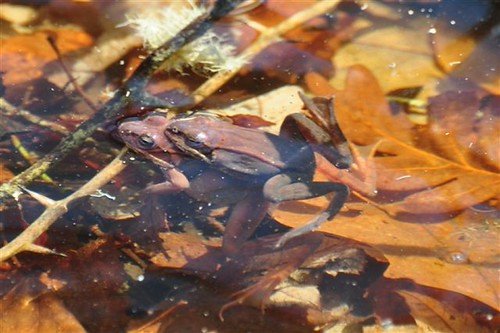
Each spring, as snow melts and rains thrummmmm!, temporary pools appear in forests and low-lying landscapes. They are often small, fleeting, and magically full of life. These are vernal pools: specialized wetland ecosystems that come alive for just a short season. Though easy to overlook, they are essential.
Vernal pools provide breeding habitat for amphibians like wood frogs and spotted salamanders, support unique species like fairy shrimp, offer food for migratory birds, help filter water, and reduce flooding.
These pop-up ecosystems offer a powerful opportunity to help students see nature not as separate parts, but as a living system of relationships—one that includes humans.
From story to connections
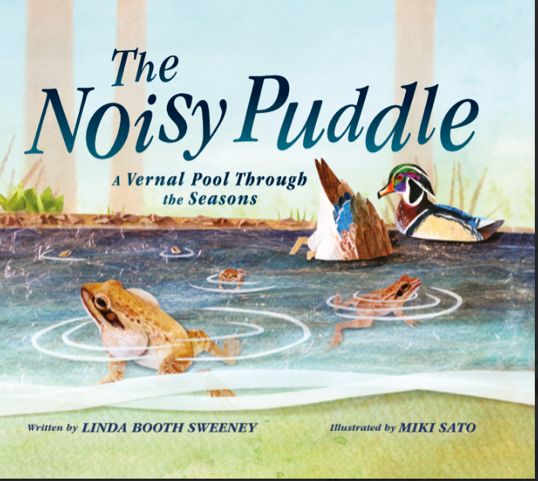
Start by reading The Noisy Puddle. Pause—especially when the pool seems to disappear! —and invite students to think like scientists and storytellers.
Ask:
- Notice: What do you see?
- Wonder: How might this be connected to that?
- Connect: What changes do you see?
These prompts help students move beyond naming objects to imagining relationships. They also support comprehension by helping students describe ideas, make predictions, and use language to explain cause and effect.
Because the book emphasizes observation and wonder, briefly introduce a few key feeding relationships before the activity:
- Fairy shrimp are eaten by predaceous diving beetles
- Aquatic worms are eaten by wood frogs
- Wood frogs may be eaten by birds such as owls
- Small aquatic organisms support larger animals like herons
Materials
- Vernal pool organism cards (e.g., fairy shrimp, water boatmen, wood frogs, herons – see the backmatter of the book for the full list of species)
- Hole punch and string (for wearable cards)
- One large ball of yarn
After reading The Noisy Puddle: A Vernal Pool Through the Seasons, invite students to play their way into a vernal pool food web. In this language-rich STEM activity, students become the organisms in a vernal pool, physically building connections with yarn while using observation, speaking, and reasoning skills to explain relationships. Students move beyond simple cause-and-effect (“who eats whom”) to understanding how living systems function as interconnected webs.
Grade level and connections
Ages: 4–8
Grades: 1–3
Science connections: natural cycles; growth and changes in plants and animals; habitats and biodiversity; scientific observation; seasonal change.
Play Becoming the Web
This hands-on game brings the system to life.
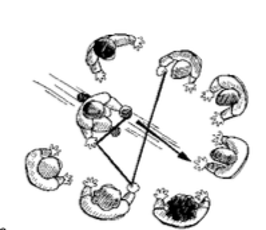
- Assign roles – Give each student an organism card to wear. Ask them to introduce themselves: “I am a wood frog. I eat… I am eaten by…”
- Have students stand in a circle. Begin with an organism low on the food chain (e.g., fairy shrimp) and give that student the yarn.
- Ask: “Who would eat you?”
- Students pass the yarn to a predator, then onward, forming a web across the circle.
- Encourage students to explain their reasoning: “I passed the yarn to ___ because…”
As students explain their choices, they are practicing speaking and listening skills, using evidence and reasoning to communicate ideas.
Examples of Food Web Chains
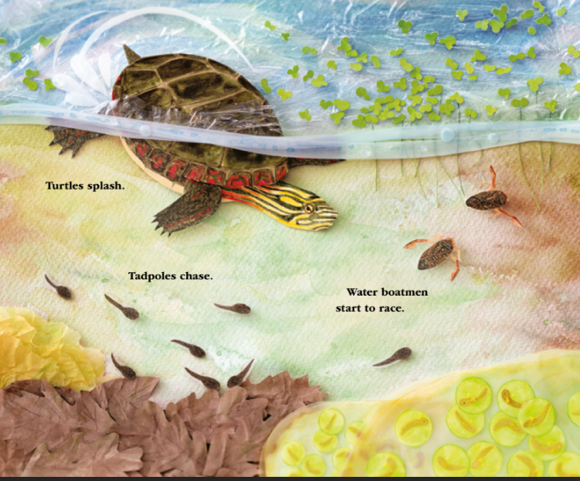
- Fairy shrimp → Predacious diving beetle → Green Heron
- Aquatic worms → Wood frogs → Barred Owl
- Pond skaters → Tadpoles → Cooper’s Hawk
From chains to systems
Pause and ask: Does this look like a straight line or something more interconnected?
Have one student gently tug the yarn and invite others to notice how the movement travels. Explain that ecosystems are not just chains, they often operate in closed loops of cause and effect (e.g. feedback loops)
For example:
More aquatic insects → more food for frogs → more frogs → fewer insects → fewer frogs → insects increase again. (Draw this on a white board as a closed loop as you explain).
Ask:
- What do you think happens if one population grows too large?
- What happens if one species disappears?
Students are building language to describe patterns of change over time, strengthening both scientific reasoning and explanatory skills.
NGSS connection: systems and system models
In this activity, students are creating a model of a real-world system, aligning with the NGSS crosscutting concept Systems and System Models.
The yarn web represents:
- Components (organisms)
- Relationships (feeding connections)
- Interactions (how changes in one part affect others)
Students use this model to ask questions, describe patterns, and explain how parts of a system interact. (More resources on helping children “think in systems”)
Extending the web: including humans
Finally, add one more connection: humans. Ask: How are humans connected to vernal pools?
Guide students to consider that vernal pools help filter water, reduce flooding, and support species that sustain larger ecosystems.
Then ask what might happen if vernal pools disappeared?
Why it matters
When students step into the web, they begin to see that living systems are not made of isolated parts, but of relationships.
They are developing the ability to observe closely, explain clearly, and make sense of the complex, interconnected world around them.
Featured image credit: “Frogs in the Kettle Pond vernal pool” by U. S. Fish and Wildlife Service – Northeast Region is marked with Public Domain Mark 1.0.
Linda Booth Sweeney is an award-winning author and systems educator who helps children and adults see the world as an interconnected web. She is the author of The Noisy Puddle and Apart, Together, and co-author of The Systems Thinking Playbook. Her next, Do Bees Pee? (coming 2026), playfully explores the circular economy and nature’s no-waste systems, where everything is reused, recycled, and part of a continuous loop. Learn more at: www.lindaboothsweeney.com Instagram: LindaBoothSweeney_Creates
Illustrator MIKI SATO, a Japanese-Canadian illustrator, uses uses a variety of different papers and fabrics to create layered, three-dimensional paper cut illustrations.


Leave a Reply
Your email is safe with me.