
• Home
  • Books
    • Beatrice and the Nightingale
    • Sharks Unhooked: The Adventures of Cristina Zenato, Underwater Ranger
    • Giant Rays of Hope: Protecting Manta Rays to Safeguard the Sea
    • A River’s Gifts: The Mighty Elwha River Reborn
    • Planet Ocean
    • Eavesdropping on Elephants
    • Neema’s Reason To Smile
    • Zoo Scientists to the Rescue
    • Sea Otter Heroes: The Predators That Saved an Ecosystem
    • Plastic, Ahoy! Investigating the Great Pacific Garbage Patch
    • Ebola: Fears and Facts
    • Jingle the Brass
    • Nugget on the Flight Deck
    • Surviving Animal Attacks
    • Elite Operations series
    • Energy Lab series
    • QuickReads Fluency Library
    • Books for English language-learners
    • Writers write all kinds of things
  • Author Visit Programs
    • FAQs
    • Calendar
  • Blog
  • Educator Resources
    • Teach the Hope
    • Earth Day Every Day newsletter archive
    • Teacher Guides
    • STEM + Literacy Activities
    • LitLinks
    • KidLit creators who make kids want to read
  • Writer Resources
    • Writing Classes
    • Manuscript or Proposal Critiques
    • How I got my start
  • Who is Patricia Newman?
  • Contact
    • Stay In Touch
    • Earth Day Every Day newsletter archive
Patricia NewmanPatricia Newman
Sibert Honor Children's Book Author & Environmentalist
  • Home
  • Books
    • Beatrice and the Nightingale
    • Sharks Unhooked: The Adventures of Cristina Zenato, Underwater Ranger
    • Giant Rays of Hope: Protecting Manta Rays to Safeguard the Sea
    • A River’s Gifts: The Mighty Elwha River Reborn
    • Planet Ocean
    • Eavesdropping on Elephants
    • Neema’s Reason To Smile
    • Zoo Scientists to the Rescue
    • Sea Otter Heroes: The Predators That Saved an Ecosystem
    • Plastic, Ahoy! Investigating the Great Pacific Garbage Patch
    • Ebola: Fears and Facts
    • Jingle the Brass
    • Nugget on the Flight Deck
    • Surviving Animal Attacks
    • Elite Operations series
    • Energy Lab series
    • QuickReads Fluency Library
    • Books for English language-learners
    • Writers write all kinds of things
  • Author Visit Programs
    • FAQs
    • Calendar
  • Blog
  • Educator Resources
    • Teach the Hope
    • Earth Day Every Day newsletter archive
    • Teacher Guides
    • STEM + Literacy Activities
    • LitLinks
    • KidLit creators who make kids want to read
  • Writer Resources
    • Writing Classes
    • Manuscript or Proposal Critiques
    • How I got my start
  • Who is Patricia Newman?
  • Contact
    • Stay In Touch
    • Earth Day Every Day newsletter archive
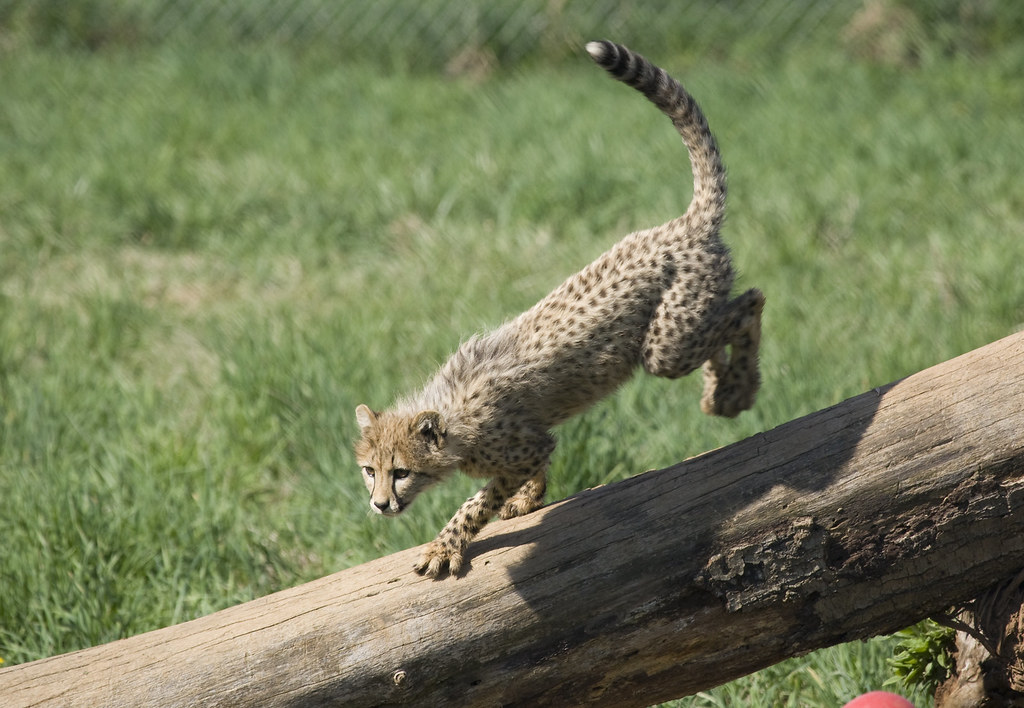
"National-Zoo's-Cheetah-Cubs:-April"-by-Smithsonian's-National-Zoo-is-licensed-under-CC-BY-NC-ND-2.0.

LitLinks: 3 easy ways animal action verbs encourage reading and writing

May 13, 2026 LitLinks, LitLinks-Grade 3-5, LitLinks-Grade K-2 No Comments
LitLinks Logo-2022

GUEST BLOGGERS TORY CHRISTIE and LUCIANA NAVARRO POWELL


While Earth Day has passed, every day is Earth Day on the Big Blue Earth! The Big Blue Earth books are lyrical poems and the perfect backdrop for lessons in action verbs (Amicus Ink by Tory Christie, illustrated by Luciana Navarro Powell). They are the perfect backdrop for lessons in action verbs. A Speedy Little Cheetah on the Big Blue Earth is the fourth book in the series. Each book starts with a close-up of a baby animal and illustrates ever-widening views showing that each animal has its own special place on our planet.  
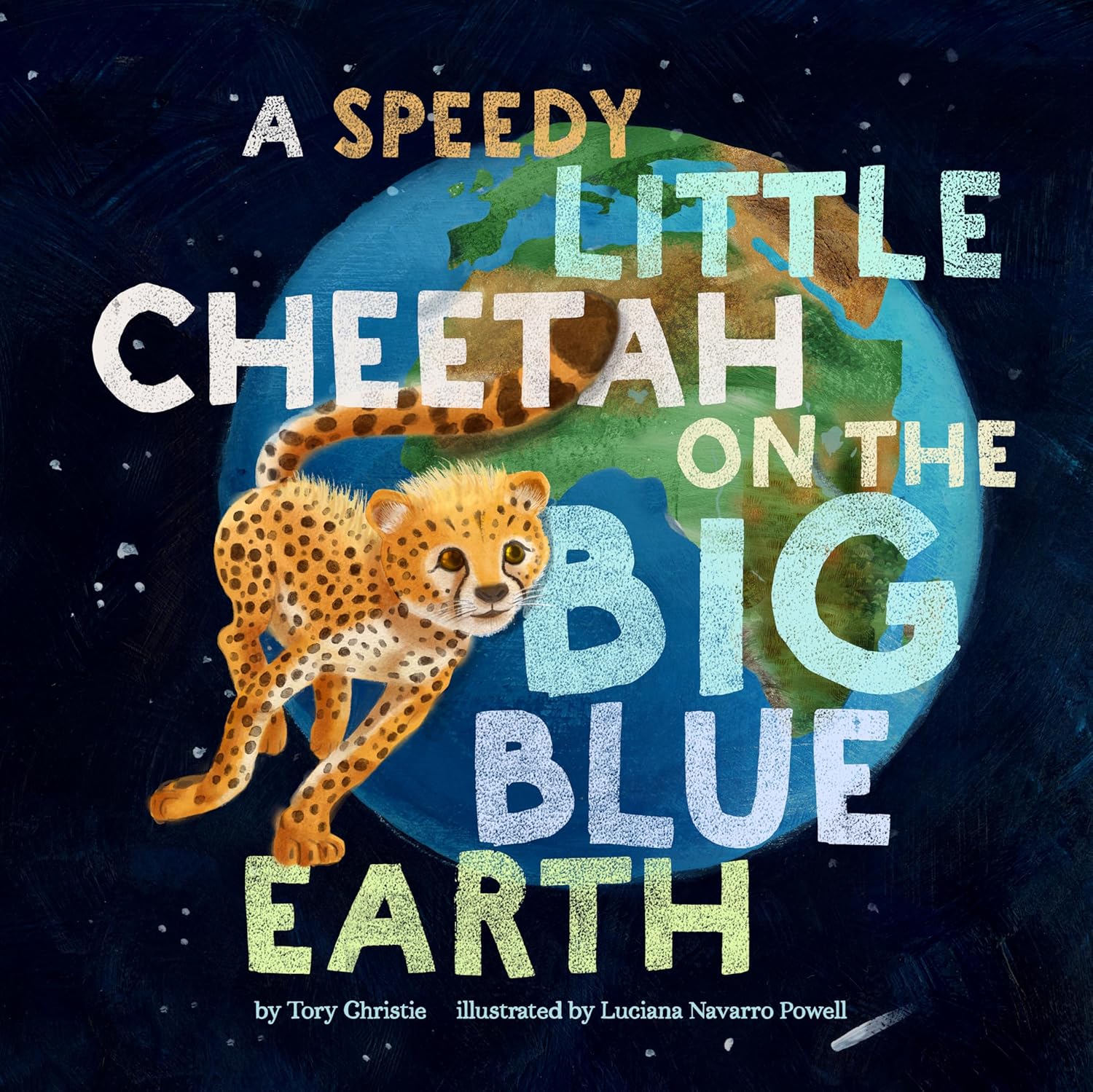
A-speedy-little-cheetah-cover

Vibrant verbs

The lively, illustrated poems in the Big Blue Earth series serve as a perfect bridge between creative storytelling and informational literacy. In A Speedy Little Cheetah on the Big Blue Earth, readers are guided from the focus of a single cheetah cub through the African savanna, discovering some vibrant verbs along the way.

You can use the book’s rhythmic prose to inspire students to experiment with dynamic language. Ultimately you’ll discover that even a simple picture book can be a sophisticated tool for building core English Language Arts (ELA) skills and global and special awareness.

Action-packed animals
action-verbs-handout

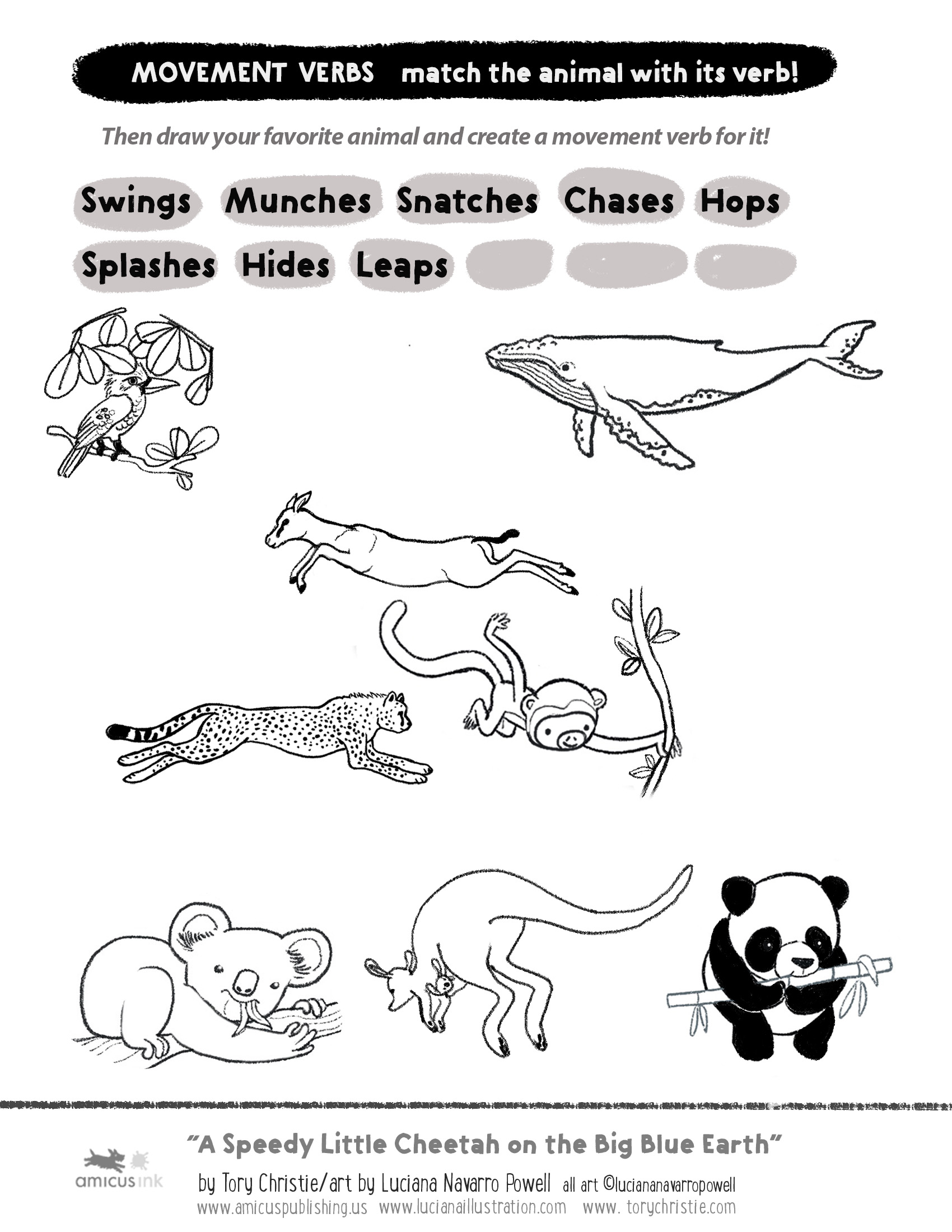
This vocabulary activity invites young learners to become word detectives. They navigate the relationship between animals, their traits, and their movements. First, read A Speedy Little Cheetah on the Big Blue Earth (or any other Big Blue Earth book). Point out the movement verbs, such as “swaying and stretching.” Encourage the kids to make these movements themselves.

Next, have students complete the MOVEMENT VERBS matching activity sheet. They will connect high-energy verbs like munching, chasing, and swinging to the animals that would make that movement. They will pair descriptive adjectives—such as speedy for the cheetah or slow for a koala—to strengthen their understanding of how specific words add detail to a story. Finally, students draw their own animal and assign it a unique verb. This reinforces their ability to use descriptive language in their own original writing.

Animation
animate-handout

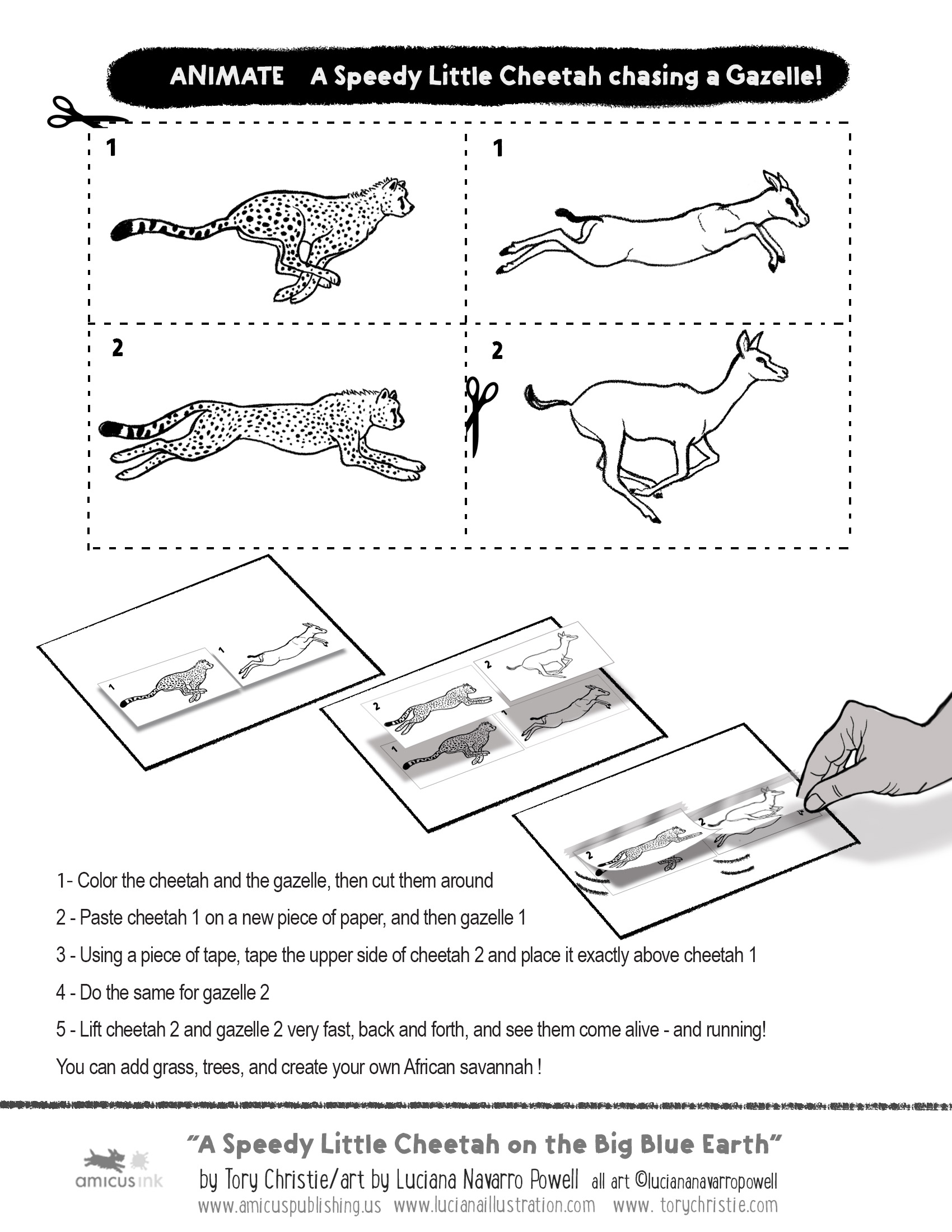
The second activity sheet is a fun way to get kids to show movement in animals. Have them get creative by coloring the cheetah and gazelle on the ANIMATE worksheet. Then follow the directions on the bottom of the sheet:

  • Color the cheetah and gazelle and cut out the four squares.
  • Place cheetah 1 and gazelle 1 on a new piece of paper.
  • Tape the upper side of cheetah 2 exactly above cheetah 1
  • Do the same for gazelle 2.
  • Lift cheetah 2 and gazelle 2 very fast, back and forth to see them ZOOM!

Extending the connection

Each Big Blue Earth book stresses the idea that we each have our own unique place on the planet. The books can also be used to enrich lessons on geography and special awareness. A Speedy Little Cheetah on the Big Blue Earth provides a unique framework for teaching students about narrative perspective and the utility of nonfiction text features like glossaries and maps.

Featured image credit: “National Zoo’s Cheetah Cubs: April” by Smithsonian’s National Zoo is licensed under CC BY-NC-ND 2.0.


Tory-Christie-headshot

Tory Christie is an earth scientist, who is also a published poet that writes children’s books about science, technology, and nature. You can find out more about her at www.torychristie.com.
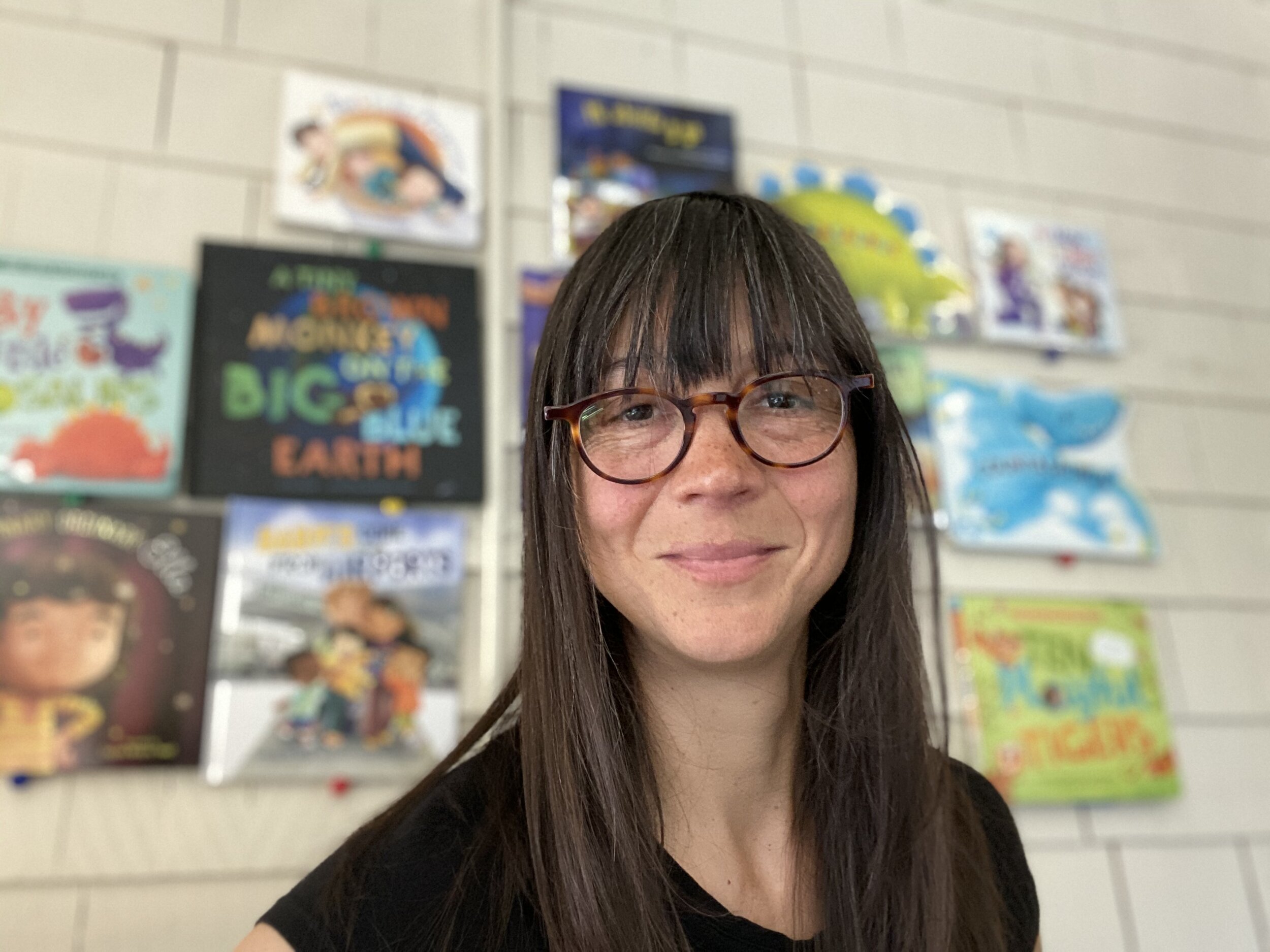
Luciana-Navarro-Powell

Luciana Navarro Powell is an artist originally from Brazil who loves to bring diverse cultures and inclusive viewpoints to her work. You can learn more about her at  www.lucianaillustration.com.

Click for more LITLINKS STEM + Literacy activities

Tags: STEM+LiteracySTEM+Literacy Natural Science
No Comments
Share
0

You also might be interested in

Mars-to-Earth-photo

LitLinks: Now students decide the Mars Rover’s final chapter

Jun 28, 2023

GUEST BLOGGER ALEXANDRA SIY Go 303,000,000 miles The book Cars[...]

Lin-Manuel_Miranda_in_Hamilton

LitLinks: An easy lesson to help students write a desert rap

Mar 15, 2023

GUEST BLOGGER DARCY PATTISON What is rap? It’s a poetic[...]

Engineering design

LitLinks: Engineering design challenge taps critical thinking and communication skills

Feb 5, 2020

GUEST BLOGGER JOAN RAMIREZ Engineering: What is it? Engineering crosses[...]

Leave a Reply

Your email is safe with me.
Cancel Reply

Click the logo to have LitLinks delivered to your inbox

LitLinks Logo-2022

Author Visits

https://youtu.be/zj6n-RFOcPA?si=8WCTnyXbTiwYumYo
https://youtu.be/ziN0UrqaDYI

Earth Day Every Day Newsletter Archive

Earth-Day-Every-Day-newsletter-banner

Post Categories:

Blog Archive

Top Posts

LitLinks: How to share our ocean connections with kids and teens

LitLinks: Let’s learn to decode photos in STEM nonfiction

LitLinks: How Elephants Can Make Your Sound Unit ROAR!

LitLinks: Easy ways to build students’ science communication skills

Proof that science connects kids to the larger world

Recent Comments

  • Cynthia Argentine on LitLinks: 5 simple steps for comparing birdsong with instrumental music Wonderful integration of music and science and nature! I'm a…
  • Cynthia Argentine on LitLinks: How to observe like a scientist and write like a poet Great observations of the links between science and poetry!
  • Margaret Quinlin on LitLinks: Exploring time and sequence in nature and narrative What a creative exercise for students!
Empowering young readers to act

Latest Blog Posts

  • LitLinks: 3 easy ways animal action verbs encourage reading and writing
    LitLinks: 3 easy ways animal action verbs encourage reading and writing
  • LitLinks: Students share ocean knowledge in a class museum
    LitLinks: Students share ocean knowledge in a class museum
  • LitLinks: Easy lesson integrating music, science, and history with birdsong
    LitLinks: Easy lesson integrating music, science, and history with birdsong

Connect with me on social media

Action Shots

Check out the STEM Tuesday Blog

© 2026 — Patricia Newman

  • Home
  • Books
    • Beatrice and the Nightingale
    • Sharks Unhooked: The Adventures of Cristina Zenato, Underwater Ranger
    • Giant Rays of Hope: Protecting Manta Rays to Safeguard the Sea
    • A River’s Gifts: The Mighty Elwha River Reborn
    • Planet Ocean
    • Eavesdropping on Elephants
    • Neema’s Reason To Smile
    • Zoo Scientists to the Rescue
    • Sea Otter Heroes: The Predators That Saved an Ecosystem
    • Plastic, Ahoy! Investigating the Great Pacific Garbage Patch
    • Ebola: Fears and Facts
    • Jingle the Brass
    • Nugget on the Flight Deck
    • Surviving Animal Attacks
    • Elite Operations series
    • Energy Lab series
    • QuickReads Fluency Library
    • Books for English language-learners
    • Writers write all kinds of things
  • Author Visit Programs
    • FAQs
    • Calendar
  • Blog
  • Educator Resources
    • Teach the Hope
    • Earth Day Every Day newsletter archive
    • Teacher Guides
    • STEM + Literacy Activities
    • LitLinks
    • KidLit creators who make kids want to read
  • Writer Resources
    • Writing Classes
    • Manuscript or Proposal Critiques
    • How I got my start
  • Who is Patricia Newman?
  • Contact
    • Stay In Touch
    • Earth Day Every Day newsletter archive
Prev