


GUEST BLOGGER MELISSA KOCH
As summer moves into fall, we feel nature’s cycles all around us: the changing seasons, the life cycles of plants and animals, the cycles within ecosystems, and the geological cycles of water and rocks. Yes, rocks! In this lesson, we’ll use the rock cycle to unlock the secret of circular stories.
The rock cycle
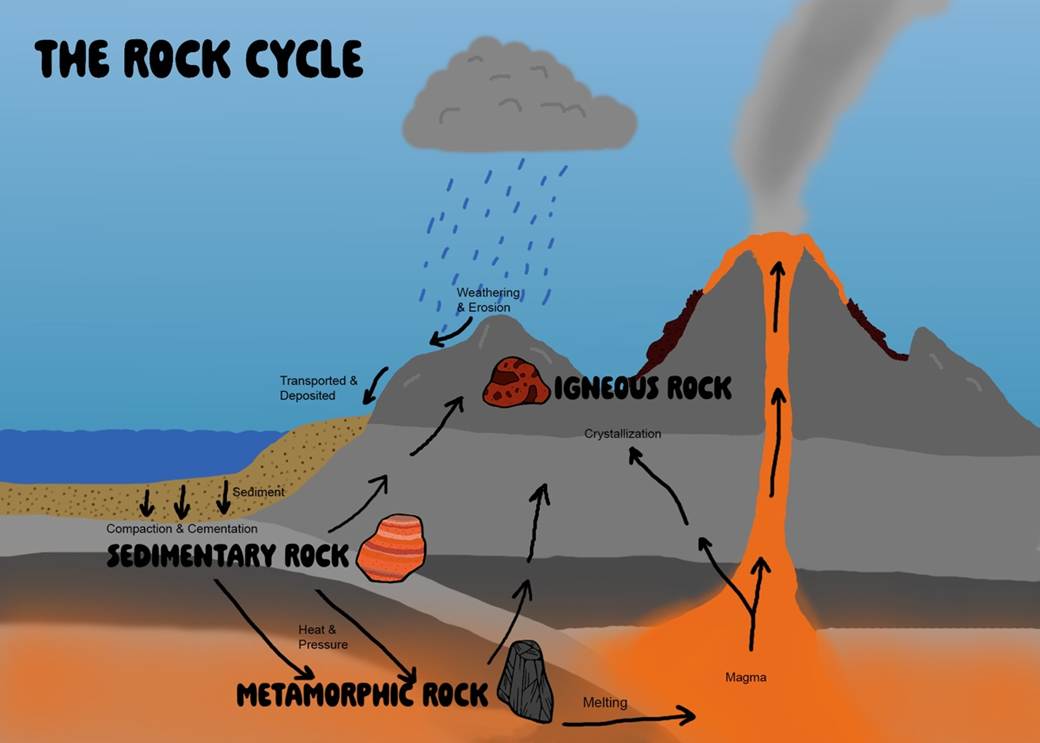
The rock cycle has always fascinated me—something that appears so solid and permanent can become something else. The forces of the Earth (wind, water, heat, pressure) shape and reshape rocks over thousands of years. Scientists categorize rocks into three types based on how they are formed: igneous, sedimentary, and metamorphic. Each of these types of rocks can become one of the other two types of rocks and magma.
Scientists also use lists to categorize and understand what they are observing. Writers use lists to show patterns and tell stories.
List structures & circular story structures
List structures a writer might use include: Descriptive, Sequence, Compare and Contrast, Question and Answer, Cause and Effect, Problem and Solution. Any of these list structures might also be a circular story. For example, If You Give a Mouse a Cookie by Laura Numeroff, a well-known circular story, also has a cause-and-effect structure.
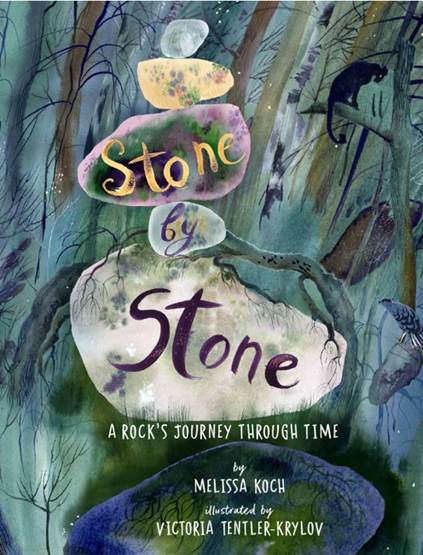
Circular story structures—when the narrative begins and ends in the same place—offer a way to connect to nature and the theme of the book. My book, Stone by Stone: A Rock’s Journey Through Time, begins with the circular story we know, the rock cycle, then connects to another circular story we often overlook about how humans use those rocks to build stone structures. I chose a circular story structure because it connects to the rock cycle and a theme of the book: like rocks, we are all connected to the Earth and each other, and we are all unique.
Circular story structure activity
Choose
Choose a cycle in nature and have students make observations about that cycle. Have students use a list structure to organize their observations.
Read
Have students read circular story structures as mentor texts aloud as a group or individually. Potential mentor texts include (see if you or your students can find others):
- Water is Water by Miranda Paul
- Stone by Stone: A Rock’s Journey Through Time by Melissa Koch
- No Monkeys, No Chocolate by Melissa Stewart
- Hawk Rising by Maria Gianferrari
- Because of an Acorn by Adam Schaefer and Lola M. Schaefer
- Flower Talk by Sara Levine
- Pumpkin Circle: The Story of a Garden by George Levenson.
- Round by Jennifer Ward
Discuss
Lead a discussion for each mentor text, asking students:
- In addition to circular structure, what structures does the author use to organize the book?
- Why do you think the author chose this structure?
- How does the circular structure relate to the other structure of the book?
- How does the circular structure relate to the nature topic in the book?
- What’s the theme of the book?
- How does circular structure relate to the theme of the book?
- What else do you notice about the use of circular story structure in this book?
Write
Have students turn their list into a circular story.
- Ask students to look at their list of observations about a cycle in nature and notice the themes and patterns in the list.
- Ask students to consider which list structure and circular structure would work for one of the themes or patterns they see.
- Have students create an outline and/or draft their story using the list and circular structures.
Enjoy the season and all of nature’s cycles!
Featured image credit: “On Bryher” by chrisotruro is licensed under CC BY-NC-SA 2.0.
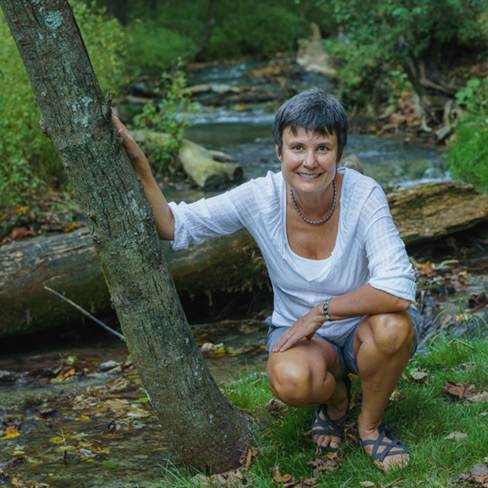
Melissa Koch writes nonfiction books for children and their teachers. Her nonfiction children’s books (picture books, middle grade, and young adult) focus on making science and social justice personal and valuable to readers. She lived in Silicon Valley for 27 years where she designed award-winning learning technologies and out-of-school learning experiences that encourage youth and young women from diverse backgrounds to pursue their dreams in science, technology, engineering, and mathematics. Her background in STEM informs her writing, teaching, and exploring of the natural world. Stone by Stone: A Rock’s Journey Through Time (Holiday House, 2026) is her debut picture book. https://www.melissakoch.com/ | https://www.instagram.com/melissakochauthor | https://www.linkedin.com/in/melissa-koch-849118 | https://www.facebook.com/MelissaKochAuthor





Leave a Reply
Your email is safe with me.