
• Home
  • Books
    • Beatrice and the Nightingale
    • Sharks Unhooked: The Adventures of Cristina Zenato, Underwater Ranger
    • Giant Rays of Hope: Protecting Manta Rays to Safeguard the Sea
    • A River’s Gifts: The Mighty Elwha River Reborn
    • Planet Ocean
    • Eavesdropping on Elephants
    • Neema’s Reason To Smile
    • Zoo Scientists to the Rescue
    • Sea Otter Heroes: The Predators That Saved an Ecosystem
    • Plastic, Ahoy! Investigating the Great Pacific Garbage Patch
    • Ebola: Fears and Facts
    • Jingle the Brass
    • Nugget on the Flight Deck
    • Surviving Animal Attacks
    • Elite Operations series
    • Energy Lab series
    • QuickReads Fluency Library
    • Books for English language-learners
    • Writers write all kinds of things
  • Author Visit Programs
    • FAQs
    • Calendar
  • Blog
  • Educator Resources
    • Teach the Hope
    • Earth Day Every Day newsletter archive
    • Teacher Guides
    • STEM + Literacy Activities
    • LitLinks
    • KidLit creators who make kids want to read
  • Writer Resources
    • Writing Classes
    • Manuscript or Proposal Critiques
    • How I got my start
  • Who is Patricia Newman?
  • Contact
    • Stay In Touch
    • Earth Day Every Day newsletter archive
Patricia NewmanPatricia Newman
Sibert Honor Children's Book Author & Environmentalist
  • Home
  • Books
    • Beatrice and the Nightingale
    • Sharks Unhooked: The Adventures of Cristina Zenato, Underwater Ranger
    • Giant Rays of Hope: Protecting Manta Rays to Safeguard the Sea
    • A River’s Gifts: The Mighty Elwha River Reborn
    • Planet Ocean
    • Eavesdropping on Elephants
    • Neema’s Reason To Smile
    • Zoo Scientists to the Rescue
    • Sea Otter Heroes: The Predators That Saved an Ecosystem
    • Plastic, Ahoy! Investigating the Great Pacific Garbage Patch
    • Ebola: Fears and Facts
    • Jingle the Brass
    • Nugget on the Flight Deck
    • Surviving Animal Attacks
    • Elite Operations series
    • Energy Lab series
    • QuickReads Fluency Library
    • Books for English language-learners
    • Writers write all kinds of things
  • Author Visit Programs
    • FAQs
    • Calendar
  • Blog
  • Educator Resources
    • Teach the Hope
    • Earth Day Every Day newsletter archive
    • Teacher Guides
    • STEM + Literacy Activities
    • LitLinks
    • KidLit creators who make kids want to read
  • Writer Resources
    • Writing Classes
    • Manuscript or Proposal Critiques
    • How I got my start
  • Who is Patricia Newman?
  • Contact
    • Stay In Touch
    • Earth Day Every Day newsletter archive
anemometer

LitLinks: 3 easy wind science activities for kids

October 21, 2026 LitLinks, LitLinks-Grade 3-5, LitLinks-Grade 6-8, LitLinks-Grade K-2 No Comments
LitLinks Logo-2022

GUEST BLOGGER HENRY HERZ

I-Am-Wind-cover

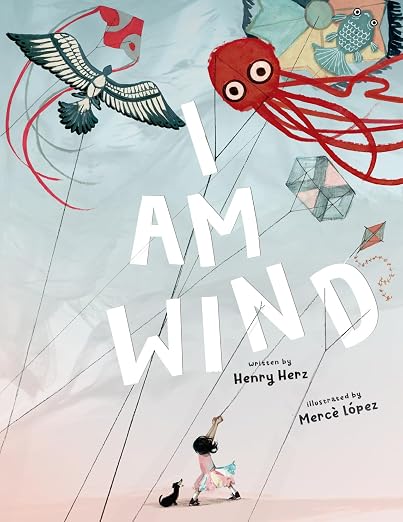
What can you smell, hear, and feel but never see? Soft as a feather or strong as a storm? Bringing comfort and delight or chaos and destruction? Wind, of course! Told in lyrical, riddling first-person narrative, Wind boasts of its essential role in life as we know it—from carving the Earth’s face to spreading seeds and pollen. I AM WIND’s back matter about the science of wind and weather enhances the book for STEM learning.

Amazing wind facts

  • Wind propelled the sailing ships of brave explorers like Ferdinand Magellan, Hanno the Navigator, Leif Erikson, Francis Drake, Piri Reis, and Zheng He to new lands.
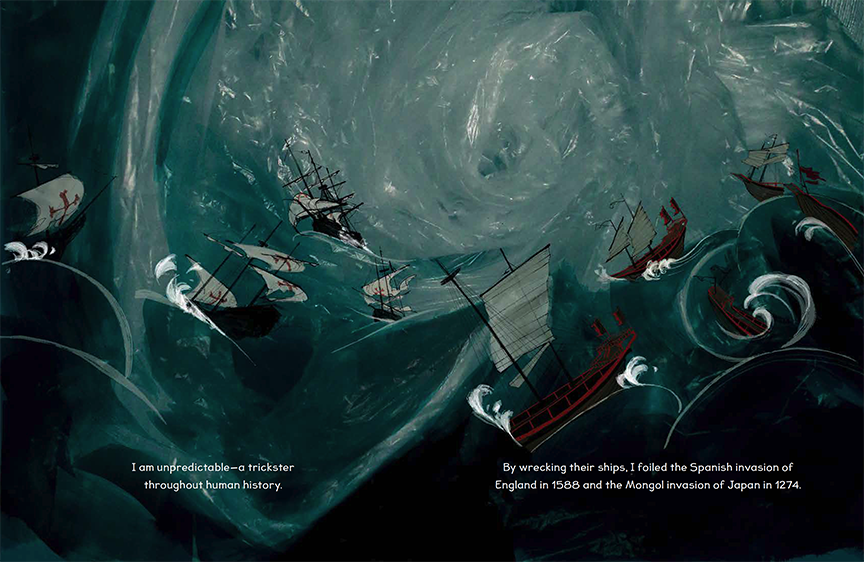
typhoon-interior-of-I-Am-Wind
From I Am Wind by Henry Herz, illustrated by Mercè López (Tilbury House Publishers, 2026)
  • Many plants require help spreading their seeds or pollen. Some well-known plant helpers are birds, bees, butterflies, and bats. But wind is also a powerful pollinator. The spread of seeds helps plants take root in new areas. But if wind blows too strongly, it can damage seedlings or make it harder for plants to grow.
  • Many animals locate their food by its scent. Wolves, foxes, and bears are predators with powerful senses of smell. Elephants use smell to detect water, even at a distance. Vultures, hyenas, Komodo dragons, and other carrion eaters locate rotting carcasses using their sense of smell. Other animals use their sense of smell to avoid predators. Some birds can detect the chemical signals given off by weasels. Rodents and rabbits will react if they smell predators like cats, ferrets, and foxes.
  • Wind helped people by turning windmills to grind grain as long as fourteen hundred years ago. Today, windmills generate electricity.
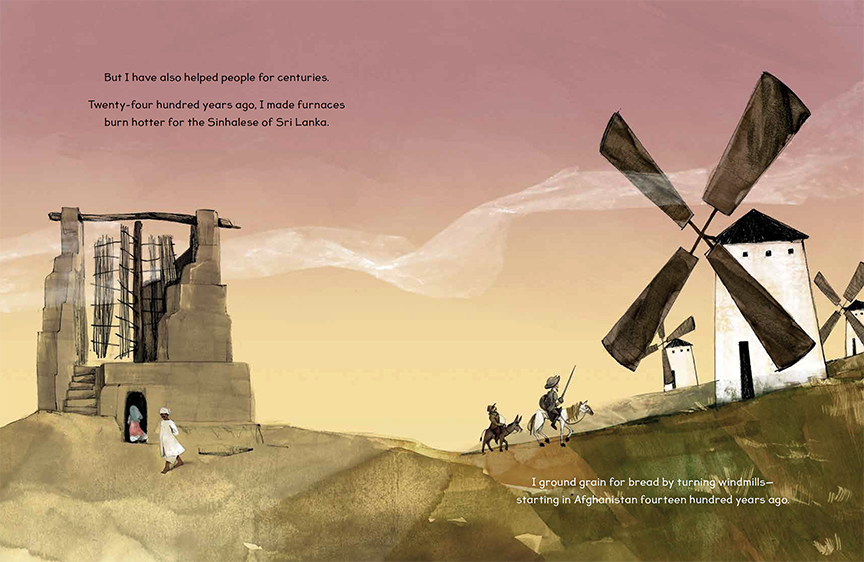
windmill-interior-from-I-Am-Wind
From I Am Wind by Henry Herz, illustrated by Mercè López (Tilbury House Publishers, 2026)
  • When wind hurls dust, it can erode hills. Wind can raise sand dunes and spread topsoil. Loess is a type of sediment formed when aeolian (windborne) dust piles up. But, when wind blows too hard, sediment deflation (the erosion of soil), occurs.
  • The Coriolis effect is caused by the Earth’s rotation and appears to deflect the movement of moving objects like air and water. Different latitudes on Earth rotate at different speeds. This causes winds to appear to curve to the right in the northern hemisphere and to the left in the southern hemisphere.

Fun with wind: Wind vane

Objective

Make a wind vane to determine the direction of the wind.

Materials needed

A pencil with an eraser on top, a drinking straw, card stock cut into the shape of an arrow head, a pin, clay or plasticine, tape or glue.

Demo

Attach the arrow head to one end of the straw. Stick the pin through the center of the straw into the pencil eraser so the straw is perpendicular to the pencil. Find a suitable outdoor location and use the clay to mount the pencil vertically. Watch how the arrow points in the direction of the wind.

Fun with Wind: Anemometer

Objective

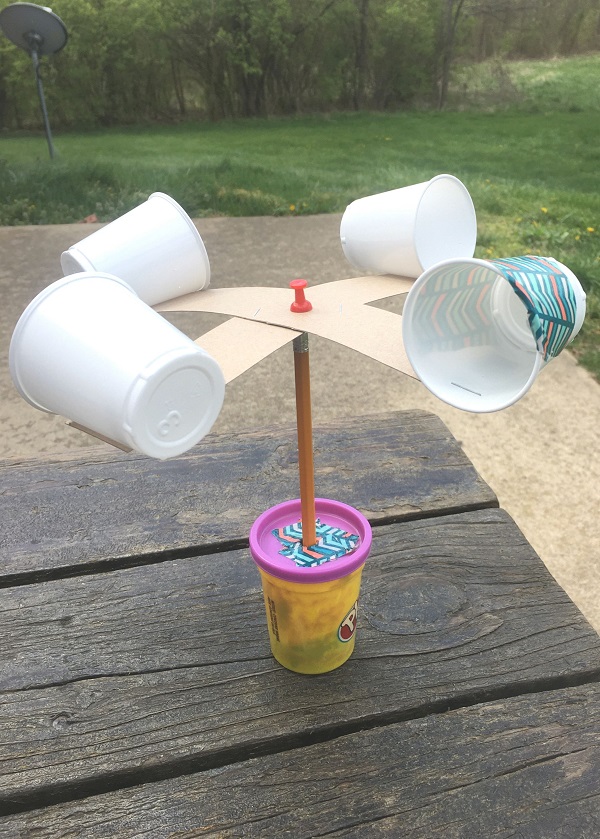
Make a wind anemometer to measure wind speed (see featured image).

Materials needed

4 paper cups, corrugated cardboard, thumbtack, hot glue gun or stapler, scissors, tape, pencil with an eraser, plasticine container.

Demo

Cut the corrugated cardboard into two 1.5” by 12” strips. Hot glue or staple the strips together to form a cross. Center the pieces as much as possible so there’s an equal length of cardboard on each side. Put tape on the outside of one cup to visually differentiate it. Staple or hot glue a cup to each end of the cardboard cross. Make sure the open ends of the cups align as shown below. Insert the lead end of the pencil vertically into the plasticine container. Stick the thumbtack through the center of the cardboard cross. Jiggle it a little so the hole is bigger than the pin. Stick the thumbtack into the pencil eraser. Check to ensure the cross can freely rotate. Take outside. Set a timer for one minute and count how many times the cup with the tape goes around in a circle. If the cup goes around ten times in one minute, the wind speed is approximately one mile per hour.  If it rotates 20 times in a minute, the wind is two miles per hour, etc. 

    Fun with wind: Balloon-powered car

    Objective

    Show how wind applies force by building a balloon-powered car.

    Materials needed

    cardboard, scissors, 3 drinking straws, 4 equal-sized plastic lids, balloon, rubber band or tape, 2 skewers.

    Demo

    Cut an hourglass-shaped car base out of cardboard. Tape a straw across each of the wide ends. Insert a skewer through each straw, and poke the skewer through a plastic lid on either end to create wheeled axles. Check to make sure the axles rotate freely. Attach a balloon to a third straw using a rubber band or tape. Tape the straw lengthwise to the other side of the car base. Inflate the balloon and set on a smooth surface. The car should roll until the force of the compressed air is exhausted.
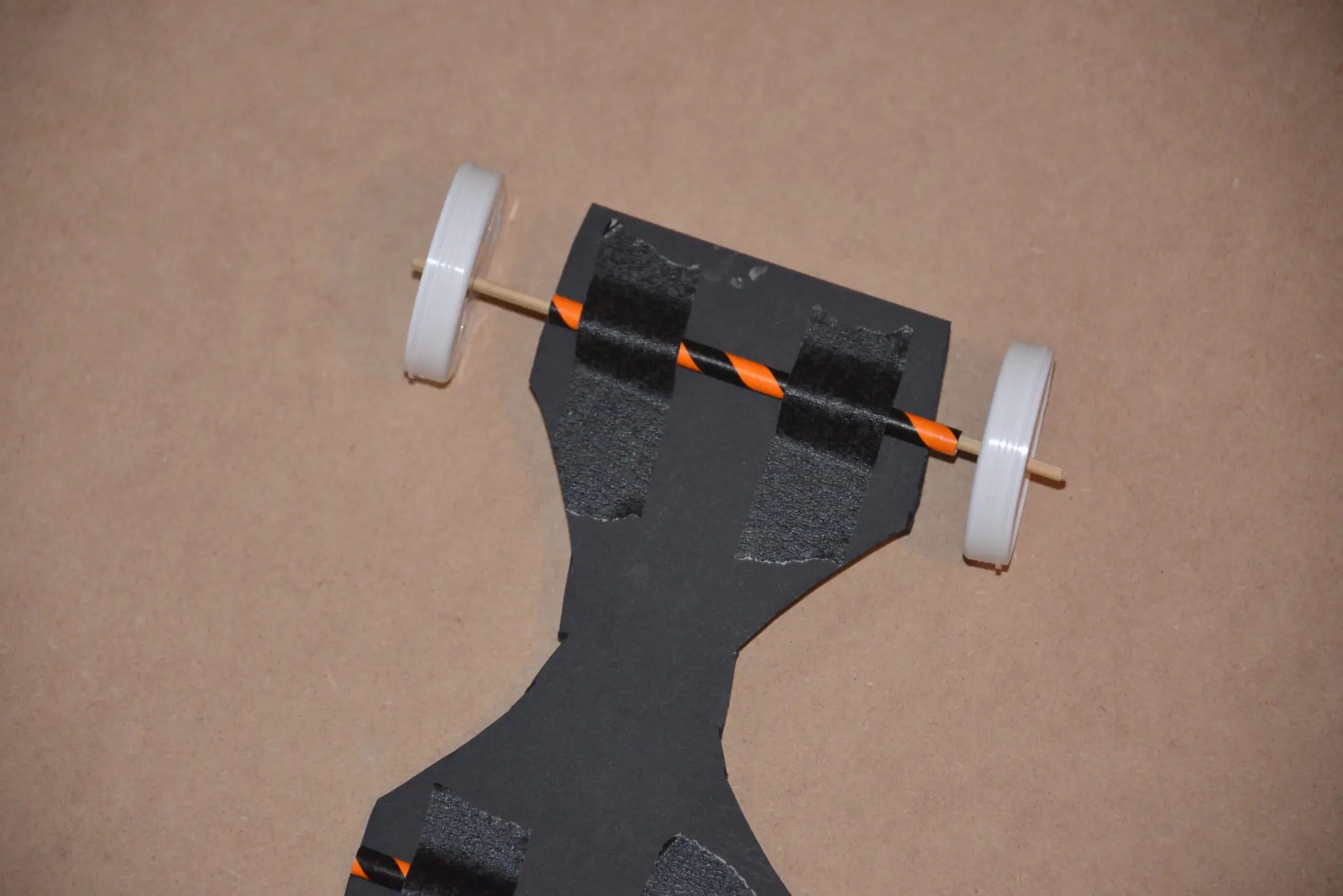
      balloon-car
      Balloon car

      Featured image credit: Anemometer courtesy of Henry Herz


      Henry-Herz_headshot

      Henry Herz is the author of fourteen picture books, including I Am Light and the award-winning I Am Smoke. Find him at henryherz.com, https://www.facebook.com/henryherzauthor, https://www.instagram.com/henry_herz/, and https://bsky.app/profile/henryherz.bsky.social

      Click for more LITLINKS STEM + Literacy activities

      Tags: STEM+LiteracySTEM+Literacy Natural ScienceSTEM+Literacy Physical Science
      No Comments
      Share
      0

      You also might be interested in

      ELP-image-for-LitLinks

      LitLinks: 3 easy animal lessons to excite kids about nature

      Jul 12, 2023

      PATRICIA NEWMAN I love animals. I’ve written several books about[...]

      flamingo

      LitLinks: How to combine ecosystems and poetry for a winning lesson

      Aug 2, 2023

      GUEST BLOGGER LESLIE BULION In GALÁPAGOS: ISLANDS OF CHANGE students[...]

      Interior spread with tanka

      LitLinks: Tanka poetry brings scientific observations to life

      Mar 18, 2020

      GUEST BLOGGER MÉLINA MANGAL Observations and tanka Biologist Ernest Everett[...]

      Leave a Reply

      Your email is safe with me.
      Cancel Reply

      Click the logo to have LitLinks delivered to your inbox

      LitLinks Logo-2022

      Author Visits

      https://youtu.be/oEZiUVKmt2k
      https://youtu.be/ziN0UrqaDYI

      Earth Day Every Day Newsletter Archive

      Earth-Day-Every-Day-newsletter-banner

      Post Categories:

      Blog Archive

      Top Posts

      LitLinks: How to share our ocean connections with kids and teens

      LitLinks: Let’s learn to decode photos in STEM nonfiction

      LitLinks: How Elephants Can Make Your Sound Unit ROAR!

      LitLinks: Easy ways to build students’ science communication skills

      Proof that science connects kids to the larger world

      Recent Comments

      • Patricia Newman on LitLinks: 3 easy sustainable food activities for the classroom Thank YOU, Kari!
      • Kari Ann Gonzalez on LitLinks: 3 easy sustainable food activities for the classroom Thank you so much for having me on your blog,…
      • Cynthia Argentine on LitLinks: 5 simple steps for comparing birdsong with instrumental music Wonderful integration of music and science and nature! I'm a…
      Empowering young readers to act

      Latest Blog Posts

      • LitLinks: 3 easy wind science activities for kids
        LitLinks: 3 easy wind science activities for kids
      • LitLinks: How to connect the American Revolution to STEM with 3 activities
        LitLinks: How to connect the American Revolution to STEM with 3 activities
      • LitLinks: 3 easy sustainable food activities for the classroom
        LitLinks: 3 easy sustainable food activities for the classroom

      Connect with me on social media

      Action Shots

      Check out the STEM Tuesday Blog

      © 2026 — Patricia Newman

      • Home
      • Books
        • Beatrice and the Nightingale
        • Sharks Unhooked: The Adventures of Cristina Zenato, Underwater Ranger
        • Giant Rays of Hope: Protecting Manta Rays to Safeguard the Sea
        • A River’s Gifts: The Mighty Elwha River Reborn
        • Planet Ocean
        • Eavesdropping on Elephants
        • Neema’s Reason To Smile
        • Zoo Scientists to the Rescue
        • Sea Otter Heroes: The Predators That Saved an Ecosystem
        • Plastic, Ahoy! Investigating the Great Pacific Garbage Patch
        • Ebola: Fears and Facts
        • Jingle the Brass
        • Nugget on the Flight Deck
        • Surviving Animal Attacks
        • Elite Operations series
        • Energy Lab series
        • QuickReads Fluency Library
        • Books for English language-learners
        • Writers write all kinds of things
      • Author Visit Programs
        • FAQs
        • Calendar
      • Blog
      • Educator Resources
        • Teach the Hope
        • Earth Day Every Day newsletter archive
        • Teacher Guides
        • STEM + Literacy Activities
        • LitLinks
        • KidLit creators who make kids want to read
      • Writer Resources
        • Writing Classes
        • Manuscript or Proposal Critiques
        • How I got my start
      • Who is Patricia Newman?
      • Contact
        • Stay In Touch
        • Earth Day Every Day newsletter archive
      Prev