
• Home
  • Books
    • Beatrice and the Nightingale
    • Sharks Unhooked: The Adventures of Cristina Zenato, Underwater Ranger
    • Giant Rays of Hope: Protecting Manta Rays to Safeguard the Sea
    • A River’s Gifts: The Mighty Elwha River Reborn
    • Planet Ocean
    • Eavesdropping on Elephants
    • Neema’s Reason To Smile
    • Zoo Scientists to the Rescue
    • Sea Otter Heroes: The Predators That Saved an Ecosystem
    • Plastic, Ahoy! Investigating the Great Pacific Garbage Patch
    • Ebola: Fears and Facts
    • Jingle the Brass
    • Nugget on the Flight Deck
    • Surviving Animal Attacks
    • Elite Operations series
    • Energy Lab series
    • QuickReads Fluency Library
    • Books for English language-learners
    • Writers write all kinds of things
  • Author Visit Programs
    • FAQs
    • Calendar
  • Blog
  • Educator Resources
    • Teach the Hope
    • Earth Day Every Day newsletter archive
    • Teacher Guides
    • STEM + Literacy Activities
    • LitLinks
    • KidLit creators who make kids want to read
  • Writer Resources
    • Writing Classes
    • Manuscript or Proposal Critiques
    • How I got my start
  • Who is Patricia Newman?
  • Contact
    • Stay In Touch
    • Earth Day Every Day newsletter archive
Patricia NewmanPatricia Newman
Sibert Honor Children's Book Author & Environmentalist
  • Home
  • Books
    • Beatrice and the Nightingale
    • Sharks Unhooked: The Adventures of Cristina Zenato, Underwater Ranger
    • Giant Rays of Hope: Protecting Manta Rays to Safeguard the Sea
    • A River’s Gifts: The Mighty Elwha River Reborn
    • Planet Ocean
    • Eavesdropping on Elephants
    • Neema’s Reason To Smile
    • Zoo Scientists to the Rescue
    • Sea Otter Heroes: The Predators That Saved an Ecosystem
    • Plastic, Ahoy! Investigating the Great Pacific Garbage Patch
    • Ebola: Fears and Facts
    • Jingle the Brass
    • Nugget on the Flight Deck
    • Surviving Animal Attacks
    • Elite Operations series
    • Energy Lab series
    • QuickReads Fluency Library
    • Books for English language-learners
    • Writers write all kinds of things
  • Author Visit Programs
    • FAQs
    • Calendar
  • Blog
  • Educator Resources
    • Teach the Hope
    • Earth Day Every Day newsletter archive
    • Teacher Guides
    • STEM + Literacy Activities
    • LitLinks
    • KidLit creators who make kids want to read
  • Writer Resources
    • Writing Classes
    • Manuscript or Proposal Critiques
    • How I got my start
  • Who is Patricia Newman?
  • Contact
    • Stay In Touch
    • Earth Day Every Day newsletter archive
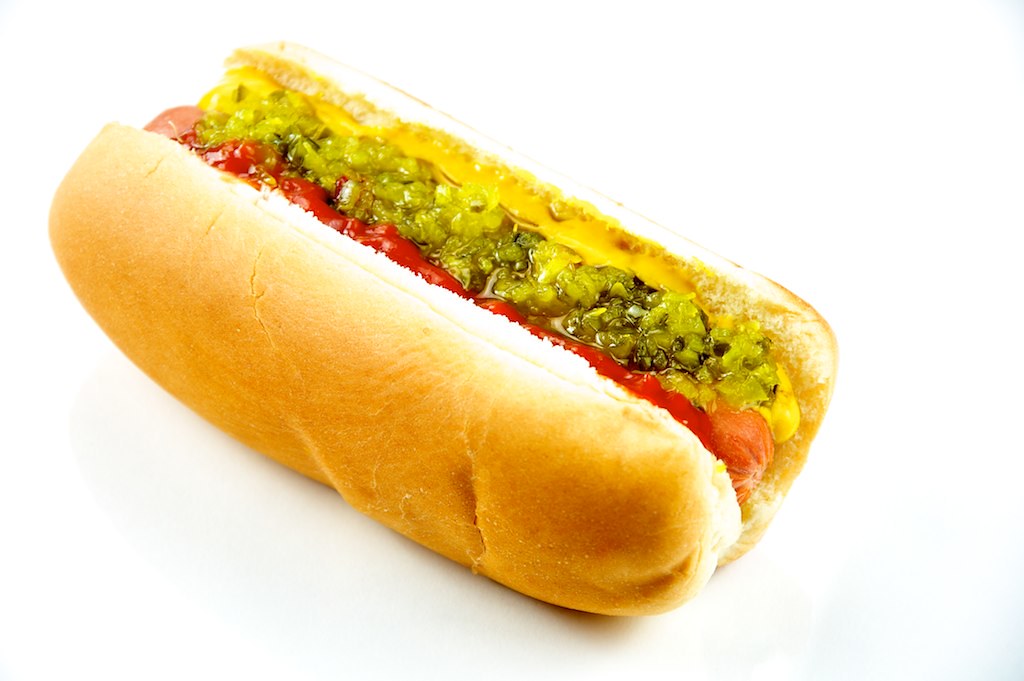
"Hot-Dog"-by-TheCulinaryGeek-is- licensed-under-CC-BY-2.0.

LitLinks: Easy ways to connect lunch with geography, history, and math lessons

July 8, 2026 LitLinks, LitLinks-Grade 3-5, LitLinks-Grade 6-8, LitLinks-Grade K-2 No Comments
LitLinks Logo-2022

GUEST BLOGGER CHRISTINE VAN ZANDT


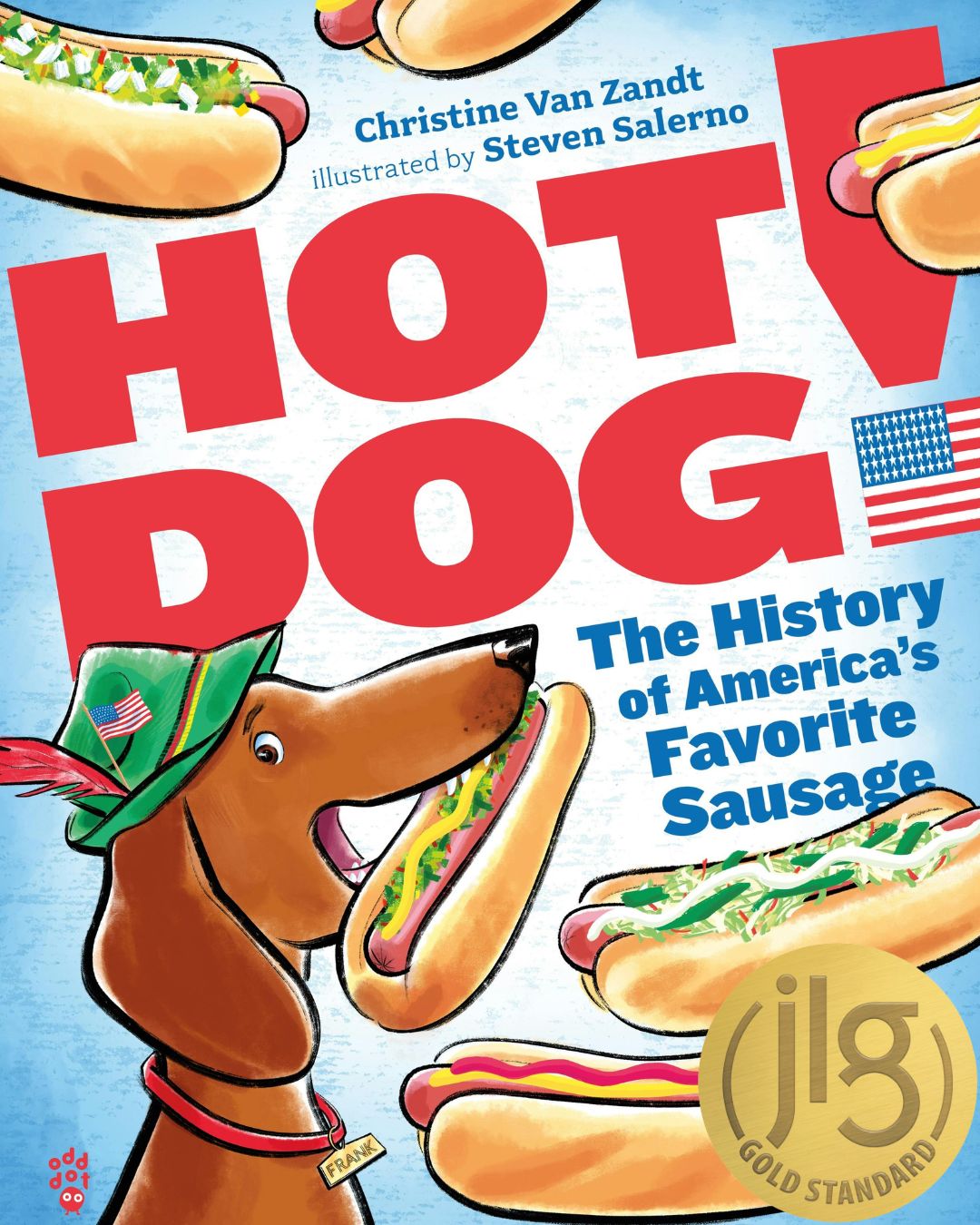
In Hot Dog! The History of America’s Favorite Sausage, young readers journey through thousands of years in time to discover how sausages became the hot dogs we know and love today. Illustrated by the renowned Steven Salerno, the scenes are filled with entertaining and interesting facts. This informational fiction picture book is narrated by Frank de Wienerdog, adding an element of fun that lets kids laugh while they learn. Hot Dog! is a 2026 Junior Library Guild gold-standard selection. Ask your class to dig in and explore some of the geography, history, and math behind this delicious meal.
Hot-Dog-cover

Activity 1

Learning objective: how to use maps to understand and communicate information (Geography standard 1)

Pre-reading geography activity

Materials: World map or globe; whiteboard, markers

Show students where they are located on the map. Ask students where they think sausages originated. Write down the most popular guesses.

Read: Hot Dog! The History of America’s Favorite Sausage

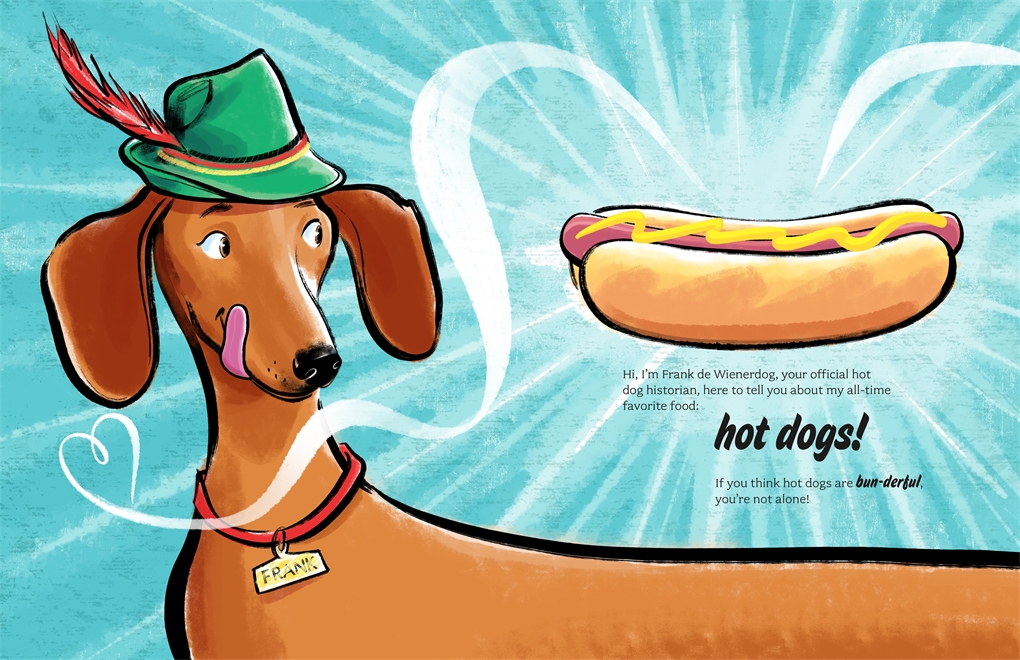
As you read, pause to refer to the world map or globe to show how sausages covered the globe. Explain that Ancient Babylon is present-day Iraq.
Hot-dog-interior-spread
From Hot Dog! The History of America’s Favorite Sausage by Christine Van Zandt, illustrated by Steven Salerno (Odd Dot, 2026)

Explain that a pun is a play on words and adds humor. Point out how “bun-derful” is a contraction of “bun” plus “wonderful.” Talk about the dual meaning of the word “linked” in the line, “You could say they (sausages) linked the world together.” As you read, ask students to raise their hands when they notice words that are puns.

Activity 2

Learning objective: Represent and solve problems involving addition and subtraction.

Post-reading math activity

Tell the students that 8 kids will be served hot dogs for lunch. There is 1 package of hot dogs and 1 package of buns.

Section One

Introduce the problem: There are 10 hot dogs per package but only 8 buns. Tell the students that math doesn’t work. And wonder why aren’t the hot dogs and buns sold in the same amounts.

Share some history with the class: There are 10 hot dogs in a package because hot dogs were traditionally sold by weight, in 1-pound increments. A pound has 16 ounces and a typical hot dog weighs 1.6 ounces. 16 ounces (1 pound) ÷ 1.6 ounces (1 hot dog) = 10 hot dogs

Now, explain the history of why buns are sold in packages of 8: Bun pans hold 4 each and are usually 2 rows per pan. 4 buns x 2 rows = 8 buns per package

Section two

Remind your students there are 8 hungry kids. Ask how they would divide up the 10 hot dogs to the 8 buns so that each student gets the same amount.

Listen to their suggestions, note them on the board, then go through this basic process to solve the problem. Draw 8 circles on the board to represent 8 plates.

Since 10 is greater than 8, every plate gets 1 hot dog. Add a hot dog on each plate on the whiteboard. Show the math: 10 – 8 = 2 hot dogs left

Section three

Now what? Ask the kids for their ideas.

To add humor, tell the kids that if Frank were here, he would say that we could feed him those two hot dogs, he doesn’t need a bun! Have the kids tell Frank, “Get your own lunch, Frank!”

Remind the students that there are 2 hot dogs left. Ask them if they’d like an easy way out? Suggest they could give 2 people each 1 extra hot dog. But that means 6 people get less food. Show the math: 8 hungry people – 2 people who get extra food = 6 people who are getting less

That’s not fair!

Section four

Ask for suggestions. When someone says to cut the 2 hot dogs left in half, take that suggestion. Draw those 2 hot dogs on the whiteboard, then draw lines down the middle of each 1.

Ask the students to count how many pieces of hot dogs that made. Show the math: 2 hot dogs ÷ 2 = 4 pieces of hot dogs

That’s getting closer, but there are still 8 hungry people waiting for lunch.

Ask for more suggestions. When someone suggests cutting them in half again, demonstrate that on the whiteboard. Have the kids count the hot dog pieces. Show the math: 4 hot dog pieces ÷ 2 = 8 hot dog pieces.

8 pieces! Yes! We have 8 people. On one plate, draw the following: Everyone gets 1 bun, 1 hot dog, and 1 hot dog piece.

Hot diggity dog, we did it! Enjoy!

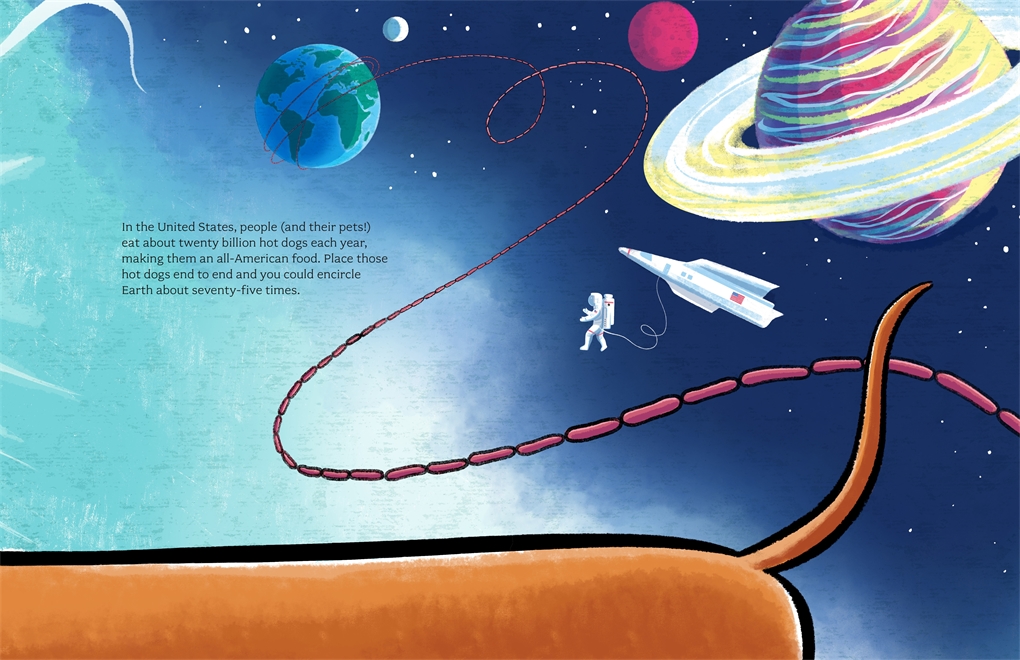
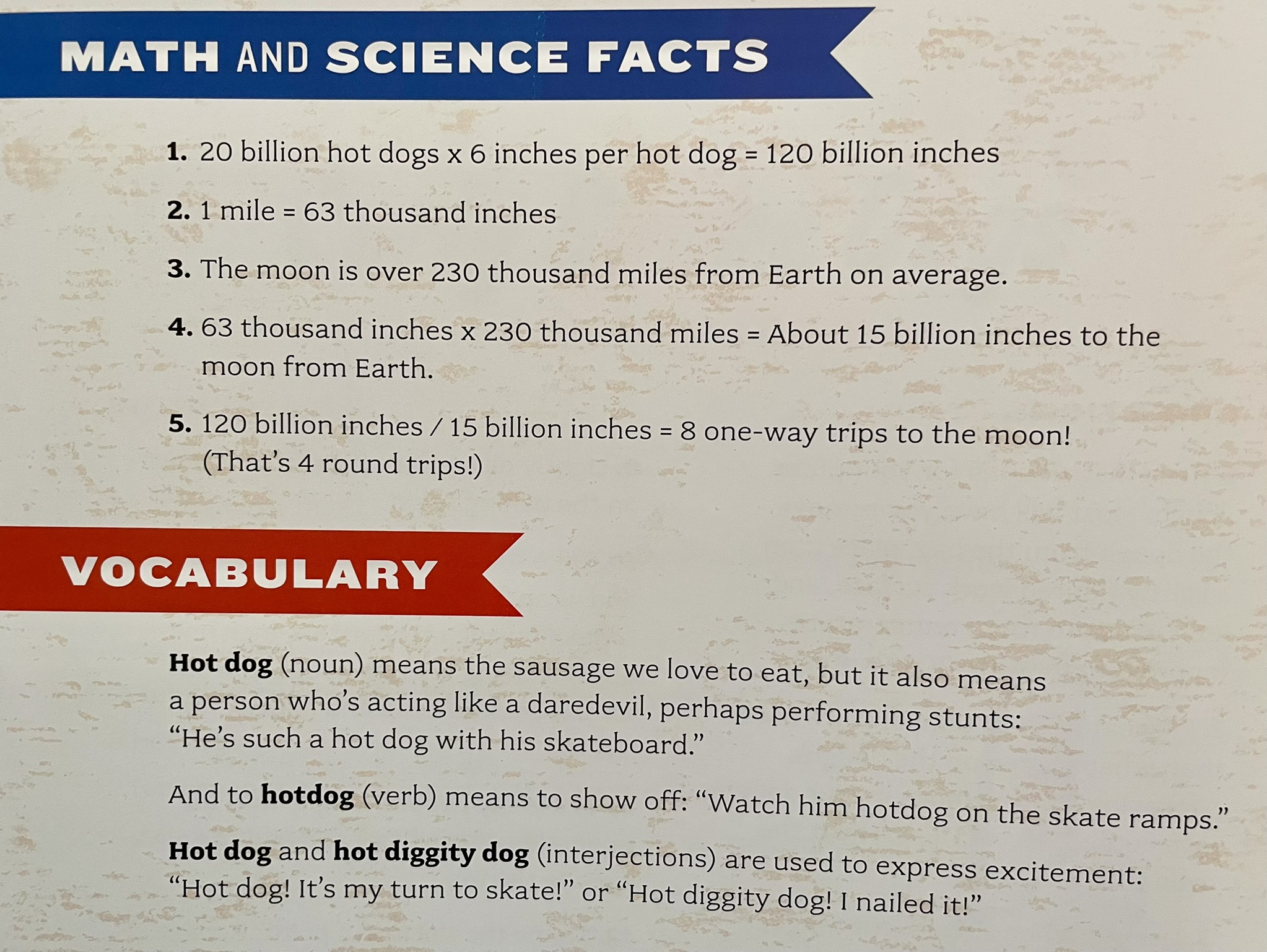
There’s more mathematical information to share. In the book, you’ll learn that the average hot dog is 6 inches long and that in the US, we eat about 20,000,000,000 (20 billion) hot dogs a year. If you placed those hot dogs end to end, you could encircle the Earth about 75 times!
hot-dog-interior-spread
From Hot Dog! The History of America’s Favorite Sausage by Christine Van Zandt, illustrated by Steven Salerno (Odd Dot, 2026)
math-science-vocabulary
From Hot Dog! The History of America’s Favorite Sausage by Christine Van Zandt, illustrated by Steven Salerno (Odd Dot, 2026)

Featured image credit: “Hot Dog” by TheCulinaryGeek is licensed under CC BY 2.0.


Christine-Van-Zandt-headshot

Christine Van Zandt is a freelance editor and book coach as well as an award-winning picture book author. She lives in Los Angeles with her family. Find her online at christinevanzandt.com, Instagram, LinkedIn, Facebook, Bluesky, and X/Twitter.

Click for more LITLINKS STEM + Literacy activities

Tags: STEM+Literacy
No Comments
Share
0

You also might be interested in

"Statue-of-Ulugh-Beg--father-of-scientific-learning-in-Samarkand"-by-Arthur-Chapman-is-licensed-under-CC-BY-NC-SA-2.0.

LitLinks: Understand the seasons with this easy activity to model the Earth’s tilt

Oct 22, 2025

GUEST BLOGGER M. O. YUKSEL If you’re looking for a[...]

LitLinks: How to watch the weather and keep a log

LitLinks: How to watch the weather and keep a log

Aug 31, 2022

GUEST BLOGGER CAROLINE ARNOLD Imagine being a lighthouse keeper–alone, a[...]

4074803597_d57104fe1a_b

LitLinks: 3 easy ways to wow your students with forensic science

Jul 20, 2022

GUEST BLOGGER CARMELLA VAN VLEET In Nothing Is Little, 11-year-old[...]

Leave a Reply

Your email is safe with me.
Cancel Reply

Click the logo to have LitLinks delivered to your inbox

LitLinks Logo-2022

Author Visits

https://youtu.be/zj6n-RFOcPA?si=8WCTnyXbTiwYumYo
https://youtu.be/ziN0UrqaDYI

Earth Day Every Day Newsletter Archive

Earth-Day-Every-Day-newsletter-banner

Post Categories:

Blog Archive

Top Posts

LitLinks: How to share our ocean connections with kids and teens

LitLinks: Let’s learn to decode photos in STEM nonfiction

LitLinks: How Elephants Can Make Your Sound Unit ROAR!

LitLinks: Easy ways to build students’ science communication skills

Proof that science connects kids to the larger world

Recent Comments

  • Cynthia Argentine on LitLinks: 5 simple steps for comparing birdsong with instrumental music Wonderful integration of music and science and nature! I'm a…
  • Cynthia Argentine on LitLinks: How to observe like a scientist and write like a poet Great observations of the links between science and poetry!
  • Margaret Quinlin on LitLinks: Exploring time and sequence in nature and narrative What a creative exercise for students!
Empowering young readers to act

Latest Blog Posts

  • LitLinks: Easy ways to connect lunch with geography, history, and math lessons
    LitLinks: Easy ways to connect lunch with geography, history, and math lessons
  • LitLinks: How to make Earth Day Every Day with #PlasticFreeJuly
    LitLinks: How to make Earth Day Every Day with #PlasticFreeJuly
  • LitLinks: Bring ELA to life with a song about farmers
    LitLinks: Bring ELA to life with a song about farmers

Connect with me on social media

Action Shots

Check out the STEM Tuesday Blog

© 2026 — Patricia Newman

  • Home
  • Books
    • Beatrice and the Nightingale
    • Sharks Unhooked: The Adventures of Cristina Zenato, Underwater Ranger
    • Giant Rays of Hope: Protecting Manta Rays to Safeguard the Sea
    • A River’s Gifts: The Mighty Elwha River Reborn
    • Planet Ocean
    • Eavesdropping on Elephants
    • Neema’s Reason To Smile
    • Zoo Scientists to the Rescue
    • Sea Otter Heroes: The Predators That Saved an Ecosystem
    • Plastic, Ahoy! Investigating the Great Pacific Garbage Patch
    • Ebola: Fears and Facts
    • Jingle the Brass
    • Nugget on the Flight Deck
    • Surviving Animal Attacks
    • Elite Operations series
    • Energy Lab series
    • QuickReads Fluency Library
    • Books for English language-learners
    • Writers write all kinds of things
  • Author Visit Programs
    • FAQs
    • Calendar
  • Blog
  • Educator Resources
    • Teach the Hope
    • Earth Day Every Day newsletter archive
    • Teacher Guides
    • STEM + Literacy Activities
    • LitLinks
    • KidLit creators who make kids want to read
  • Writer Resources
    • Writing Classes
    • Manuscript or Proposal Critiques
    • How I got my start
  • Who is Patricia Newman?
  • Contact
    • Stay In Touch
    • Earth Day Every Day newsletter archive
Prev