

• Home
  • Books
    • Beatrice and the Nightingale
    • Sharks Unhooked: The Adventures of Cristina Zenato, Underwater Ranger
    • Giant Rays of Hope: Protecting Manta Rays to Safeguard the Sea
    • A River’s Gifts: The Mighty Elwha River Reborn
    • Planet Ocean
    • Eavesdropping on Elephants
    • Neema’s Reason To Smile
    • Zoo Scientists to the Rescue
    • Sea Otter Heroes: The Predators That Saved an Ecosystem
    • Plastic, Ahoy! Investigating the Great Pacific Garbage Patch
    • Ebola: Fears and Facts
    • Jingle the Brass
    • Nugget on the Flight Deck
    • Surviving Animal Attacks
    • Elite Operations series
    • Energy Lab series
    • QuickReads Fluency Library
    • Books for English language-learners
    • Writers write all kinds of things
  • Author Visit Programs
    • FAQs
    • Calendar
  • Blog
  • Educator Resources
    • Teach the Hope
    • Earth Day Every Day newsletter archive
    • Teacher Guides
    • STEM + Literacy Activities
    • LitLinks
    • KidLit creators who make kids want to read
  • Writer Resources
    • Writing Classes
    • Manuscript or Proposal Critiques
    • How I got my start
  • Who is Patricia Newman?
  • Contact
    • Stay In Touch
    • Earth Day Every Day newsletter archive
Patricia NewmanPatricia Newman
Sibert Honor Children's Book Author & Environmentalist
  • Home
  • Books
    • Beatrice and the Nightingale
    • Sharks Unhooked: The Adventures of Cristina Zenato, Underwater Ranger
    • Giant Rays of Hope: Protecting Manta Rays to Safeguard the Sea
    • A River’s Gifts: The Mighty Elwha River Reborn
    • Planet Ocean
    • Eavesdropping on Elephants
    • Neema’s Reason To Smile
    • Zoo Scientists to the Rescue
    • Sea Otter Heroes: The Predators That Saved an Ecosystem
    • Plastic, Ahoy! Investigating the Great Pacific Garbage Patch
    • Ebola: Fears and Facts
    • Jingle the Brass
    • Nugget on the Flight Deck
    • Surviving Animal Attacks
    • Elite Operations series
    • Energy Lab series
    • QuickReads Fluency Library
    • Books for English language-learners
    • Writers write all kinds of things
  • Author Visit Programs
    • FAQs
    • Calendar
  • Blog
  • Educator Resources
    • Teach the Hope
    • Earth Day Every Day newsletter archive
    • Teacher Guides
    • STEM + Literacy Activities
    • LitLinks
    • KidLit creators who make kids want to read
  • Writer Resources
    • Writing Classes
    • Manuscript or Proposal Critiques
    • How I got my start
  • Who is Patricia Newman?
  • Contact
    • Stay In Touch
    • Earth Day Every Day newsletter archive
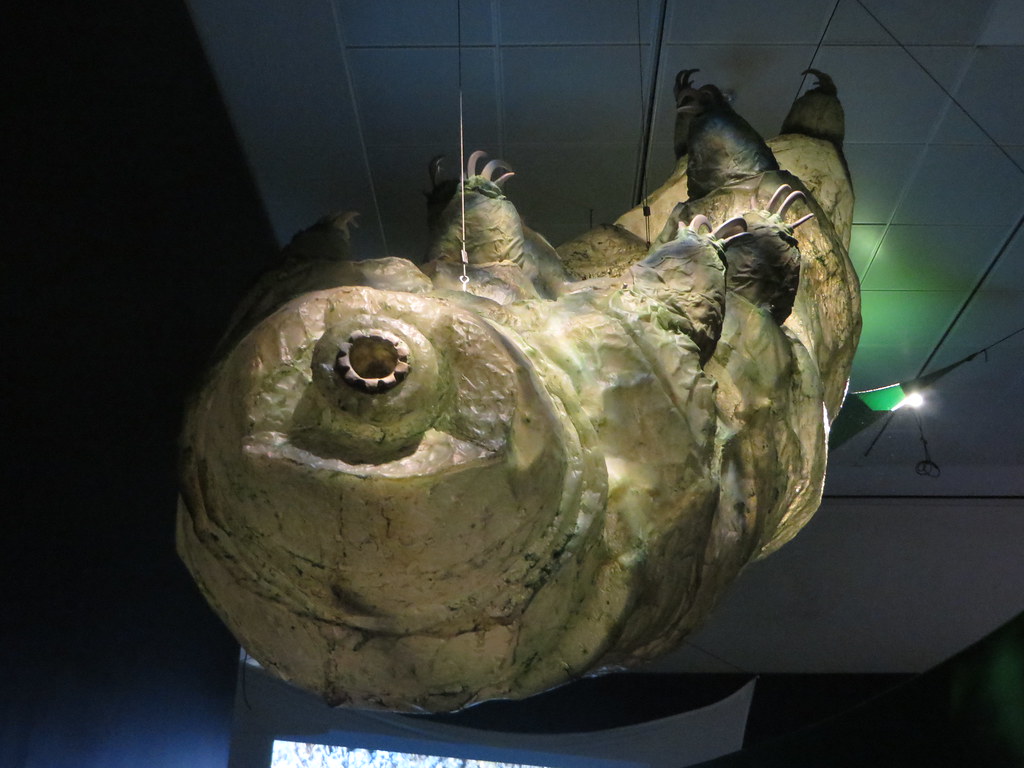
"Tardigrade"-by-edenpictures-is-licensed-under-CC-BY-2.0.

LitLinks: How to creatively present science vocabulary

February 11, 2026 LitLinks, LitLinks-Grade 3-5, LitLinks-Grade 6-8 No Comments
LitLinks Logo-2022

GUEST BLOGGER KATHRYN HULICK


Scientists and engineers use a lot of tricky vocabulary. Learning what these words mean can help students better understand both real life science and science fiction stories. In this activity, students will choose a scientific word or phrase to learn about. Then, they will create a video, reel, or poster about the vocabulary word and present it to their classmates.
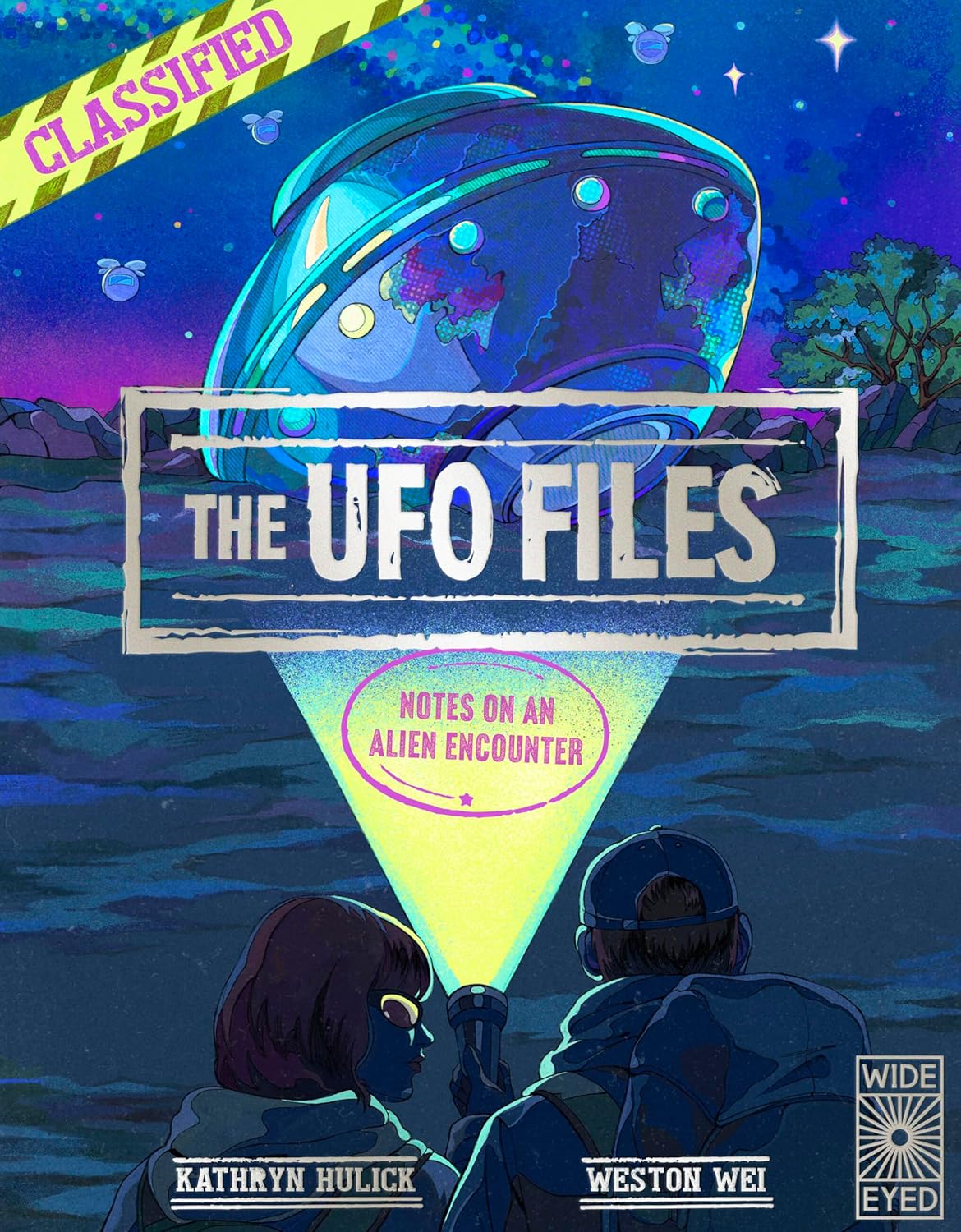
UFO-Files-cover

All of the vocabulary below comes from the science fiction book The UFO Files: Notes on an Alien Encounter (Quarto, 2025). This middle grade graphic novel is presented as if you are reading a personal notebook compiled by a UFO investigator known only as Polaris, documenting the arrival of an alien spacecraft on Planet Earth in the year 2033. Piece by piece, readers uncover a thrilling narrative of courage and curiosity during this closest of encounters, while nonfiction sidebars delve into the cutting-edge science and technology that help Polaris understand—and welcome—visitors from a distant star system.

The activity below is just one of four included in a free Educator Guide for THE UFO FILES.

Science vocabulary activity

Preparation
  • Introduce the book The UFO Files and discuss how learning scientific vocabulary can help people better understand real science as well as science fiction.
  • Have students work alone or in pairs. Assign words from the following list.
    • Technosignature (page 8-9)
    • Frequency (page 10-11)
    • Nanotechnology (page 24-25)
    • Xenolinguist (page 36-37)
    • Generative adversarial network (page 38-39)
    • Infrared (page 40-41)
    • Fusion (page 54-55)
    • Pulsar (page 64-65)
    • Exoplanet (page 68-69)
    • Rocket propulsion (page 72-73)
    • Cryptobiosis (page 84-85)
    • Tardigrades (page 84-85)
    • Photosynthesis (page 88-89)
    • Bioluminescence (page 90-91)
    • Superconducting magnets (page 56-57) 
Reading + research
  • Students open The UFO Files to the page numbers indicated and find all instances of their vocabulary term.
  • Using context clues on the page, students write down what they think their term means.
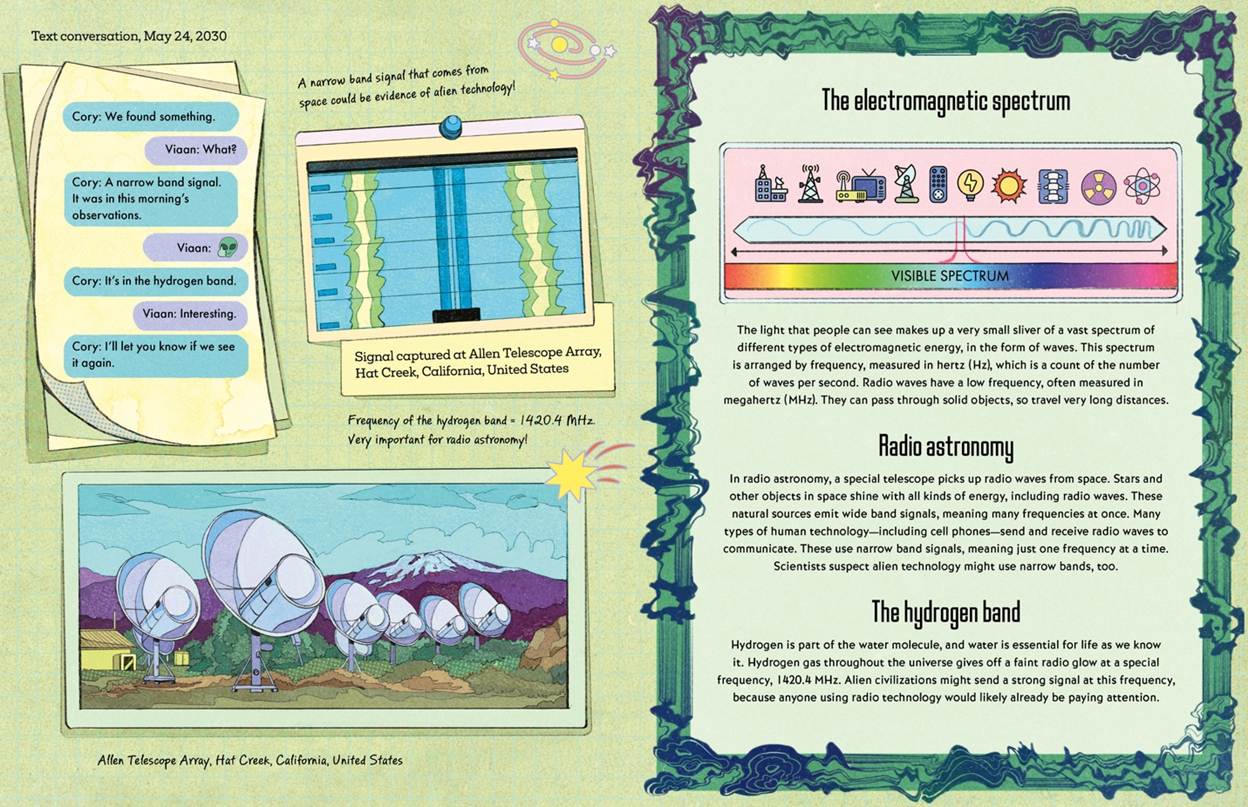
The-UFO-Files-interior-spread
This spread has information about the vocabulary word “frequency.” The text gives a definition that students can discover: frequency is a count of the number of waves per second. From The UFO Files by Kathryn Hulick, illustrated by Weston Wei (Quarto, 2025).

  • Students spend 10-15 minutes researching their term online to find out the definition and additional information that can help explain its meaning. Students should seek out images, video, and graphics as well as text. They should double-check any information they get from AI or chatbots, as this technology can introduce errors.
Creative project
  • At home or during at least 1 hour of class time (this could be split over a few days), students create short videos, reels, or posters to present their vocabulary terms. They should have fun with this and get creative. The end result should be factual and informative as well as engaging – something that would likely get clicks or views online.
  • Students share their creations with the rest of the class.

Check out more activities in the free Educator Guide for THE UFO FILES.

Featured image credit: “Tardigrade” by edenpictures is licensed under CC BY 2.0.


Kathryn-Hulick-headshot

Kathryn Hulick is a freelance journalist and author of numerous books for young people or anyone who is curious. Her new book THE UFO FILES: Notes on an Alien Encounter (Quarto, 2025) combines a sci-fi story about the arrival of an alien spacecraft with scientific explanations of the marvels found on board. Her previous two books, Welcome To The Future (Quarto, 2021) and Strange But True (Quarto, 2019) are both nonfiction for young readers. She also writes news and features for Science News, Science News Explores, and Sierra Magazine. Her Substack is called Wow! Tech & Nature. She enjoys hiking with her family and dog, painting, reading, and growing unusual orchids. Follow her work on Substack: https://kathrynhulick.substack.com/

Click for more LITLINKS STEM + Literacy activities

Tags: STEM+LiteracySTEM+Literacy Natural ScienceSTEM+Literacy Physical Science
No Comments
Share
0

You also might be interested in

velellas with plastic bits -- eco-friendly

LitLinks: Use this not that–making eco-friendly choices

Jul 22, 2020

BY PATRICIA NEWMAN It’s summer! Time to play on the[...]

emperor-penguins

LitLinks: 4 ways to teach Emperor penguins across your curriculum

Jun 19, 2024

GUEST BLOGGER DEBORAH LEE ROSE In PENGUINS READY TO GO,[...]

30124079854_3e972e5aab_b

LitLinks: Why Wonder Woman is great for teaching the senses

Oct 3, 2021

GUEST BLOGGER KIRSTEN W. LARSON A special Sunday edition of[...]

Leave a Reply

Your email is safe with me.
Cancel Reply

Click the logo to have LitLinks delivered to your inbox

LitLinks Logo-2022

Author Visits

https://youtu.be/zj6n-RFOcPA?si=8WCTnyXbTiwYumYo
https://youtu.be/ziN0UrqaDYI

Earth Day Every Day Newsletter Archive

Earth-Day-Every-Day-newsletter-banner

Post Categories:

Blog Archive

Top Posts

LitLinks: How to share our ocean connections with kids and teens

LitLinks: Let’s learn to decode photos in STEM nonfiction

LitLinks: How Elephants Can Make Your Sound Unit ROAR!

LitLinks: Easy ways to build students’ science communication skills

Proof that science connects kids to the larger world

Recent Comments

  • Margaret Quinlin on LitLinks: Exploring time and sequence in nature and narrative What a creative exercise for students!
  • Sue Heavenrich on LitLinks: Great ideas to help students practice the art of asking questions Great post, Jessica! I love the way the "I notice"…
  • Lisa L. Owens on LitLinks: 4 ways Pluto can supercharge imagination Thanks for hosting me, Patricia!
Empowering young readers to act

Latest Blog Posts

  • LitLinks: How to creatively present science vocabulary
    LitLinks: How to creatively present science vocabulary
  • LitLinks: 12 incredible women who put men on the moon
    LitLinks: 12 incredible women who put men on the moon
  • LitLinks: An easy way to explore rhythms and patterns in language and nature
    LitLinks: An easy way to explore rhythms and patterns in language and nature

Connect with me on social media

Action Shots

Check out the STEM Tuesday Blog

© 2026 — Patricia Newman

  • Home
  • Books
    • Beatrice and the Nightingale
    • Sharks Unhooked: The Adventures of Cristina Zenato, Underwater Ranger
    • Giant Rays of Hope: Protecting Manta Rays to Safeguard the Sea
    • A River’s Gifts: The Mighty Elwha River Reborn
    • Planet Ocean
    • Eavesdropping on Elephants
    • Neema’s Reason To Smile
    • Zoo Scientists to the Rescue
    • Sea Otter Heroes: The Predators That Saved an Ecosystem
    • Plastic, Ahoy! Investigating the Great Pacific Garbage Patch
    • Ebola: Fears and Facts
    • Jingle the Brass
    • Nugget on the Flight Deck
    • Surviving Animal Attacks
    • Elite Operations series
    • Energy Lab series
    • QuickReads Fluency Library
    • Books for English language-learners
    • Writers write all kinds of things
  • Author Visit Programs
    • FAQs
    • Calendar
  • Blog
  • Educator Resources
    • Teach the Hope
    • Earth Day Every Day newsletter archive
    • Teacher Guides
    • STEM + Literacy Activities
    • LitLinks
    • KidLit creators who make kids want to read
  • Writer Resources
    • Writing Classes
    • Manuscript or Proposal Critiques
    • How I got my start
  • Who is Patricia Newman?
  • Contact
    • Stay In Touch
    • Earth Day Every Day newsletter archive
Prev